Creativity is allowing yourself to make mistakes. Art is knowing which ones to keep. Musings from someone who sees stories everywhere.

Saturday, January 25, 2014

Blackbirds in The Pomegranate Tree: A writerly friendship

I first met Mary Ellen Sanger in Francis Ford Coppola's Zoetrope Virtual Studios way back in 2002. She was an American living and working in Mexico, and her short stories spoke of poor Mexicans and smelt of green trees and fields of their world. Her writing showed a deep empathy for the people among whom she then lived.
Mary Ellen Sanger

We exchanged critiques on each others stories and stayed in touch through the years, forging warm ties. Life went on smoothly until we heard the shocking news of her incarceration in a Mexican prison for no fault of hers. She found her way to freedom after a life-changing experience, which has inspired her new book,
Blackbirds in the PomegranateTree: Stories from Ixcotel State Prison
Indian readers can get it here

 Mary Ellen Sanger spent 33 days in Ixcotel State Prison in the fall of 2003. These stories of the women she met there, illuminate her biggest surprise and her only consolation in prison: the solidarity that formed among the women she lived, ate, swept and passed long days with while inside. Nine lyrical tales show the depth of emotions that insist on their own space, even in these harshest of circumstances. The largest and brawniest woman in the prison, doing time for armed robbery, kills a rat with her foot, then turns to the author for help with a very special letter. Another young woman, only nineteen years old, has already been in for three years, guilty of kidnapping her own child. And Ana, a political prisoner, teaches the author about creative ways to turn the tide, one including frog-eating snakes. Mary Ellen weaves her own tale through the stories. Accused of a crime that doesn't exist by a powerful man in Mexico, she depends on the fierce solidarity of friends on the outside, and a brilliant lawyer who trusts in the rule of law... even in Mexico. The women incarcerated in Ixcotel State Prison said that the blackbirds chattered in the lone pomegranate tree in the courtyard whenever a woman was about to be released. They are chattering now.


Chiapas, Mexico, birthplace of the Batista movement
Here's what she shared with me about her experiences, and the story behind the book.


When I returned to the US after being unjustly imprisoned for 33 days in Mexico, I thought I left prison behind me. But I realized the women I met inside, their surprising solidarity, the sense of community we built together and the many injustices I shared with them in their stories, stayed close with me. I wrote “Blackbirds in the Pomegranate Tree: Stories from Ixcotel State Prison” to share my own experiences in Mexico – most of those experiences lush and full of color – and the story of how the (in)justice system prevalent there seems destined to imprison some of the most innocent of Mexico’s population. And me.


1. Which writers influenced you the most, and why?
Elena Poniatowska, the First Lady of Mexican Letters, graced me with an introduction to my book. We made a sweet friendship several years ago through a chance meeting. I respect her writing for its focus on Mexico’s women, many who are victims of poverty and social inequities. One of my favorite writers on the planet is Uruguayan writer Eduardo Galeano, whose lyrical style I could only hope to emulate. Give me Eduardo Galeano any time of day or night.

2. What is your experience re self-publishing? E-book vs print?
I self-published “Blackbirds” because my life was too full or work and volunteering and falling in love and moving, to do the intensive research and time-consuming work of finding an agent – which is quite a challenge in the US these days. I tried, and found several who were interested, but not enough. I wanted the book to be out for the tenth anniversary of my release from prison, so I popped it in the queue. It had been edited with the help of a professional editor friend, so I was confident of its quality in that respect. The shift to indie presses and self-publishing is a remarkable surge. However, the ease with which one can enter into self-publishing does flood the field with some astonishingly weak manuscripts, many poorly edited. So I am up against a hearty stigma still – though I do trust that with the proper exposure, and the attention given by people interested in the world of social justice – that my book can cut through the preconceptions around self-published works. I did make the book available in Kindle (e-book) format, which has enriched sales by 20%, as some of my audience is in Mexico and the book is more quickly delivered electronically.

3. Is the craft of writing receding in importance in a world where shoddily written but slickly marketed work dominates?
I hope the craft of writing is even MORE important in that world you describe. We recognize good writing. We find our way to it. Good writing (that is, talented writing!) is a necessary craft, an antidote if you will – to the instant and slick. If you can make a delicious slow-simmered sauce – that should win out any day over a squeeze-packet of mayonnaise!

4. Would you return to Mexico if things improve there?
I return to Mexico every year. I cannot be too far from her! The justice system is changing… at a glacially slow pace. As of 2008, there has been a mandate to allow for oral trials, and the country is slowly putting in place new practices. It is, however, a long history to counter. It will take time. Meanwhile, I visit each year, I eat my slow-simmered sauces! And I drink in what music and magic I can.
 

Photo: Of the nine incarcerated women I met inside:

For those of you who have read Blackbirds in the Pomegranate Tree: Stories from Ixcotel State Prison --

Which woman's voice stays with you most? Why?
One of the nine imprisoned women whom Sanger met and has written about.

5. What are you working on now?
Thank you for asking! I am trying to write a poem-a-day, as a part of a project started in 2010 with a friend, in honor of National Poetry Month in April. We were going to write those daily poems for one month, but we liked the practice so much we kept on going! We have put out a book of these quickie, unedited poems every year since 2010. Finishing up for 2013. Other than that, a novel is cooking in my head right now, which should involve Mexico and dancing! I won’t say any more. Still simmering!
 
Indian readers can get the book here


Sunday, January 19, 2014

Indian Railways, a window to our culture


I'm a recent entrant to the world of Quora and am finding it a fascinating forum for exchanging a wide range of experiences and ideas. What I like best here is the depth and variety of the posts by members. Quite the opposite of the superficial drivel that can often clutter Facebook.

I saw a question asked by a member, "What do you think of when you hear the words Indian Railways?" Here's what I shared about one of my favourite train journeys:
Apart from that lovely song, Toofan Mail', my favourite train journey used to be on the Karnataka Express from Delhi to Bangalore way back in the Eighties of the previous century.

This route, connecting the North to the South, gave a wonderful panoramic view of India, better than any textbook or documentary film. From 'chai garam' to 'sooda' or 'bisi' kaapi, from aloo paranthas and cutlets to idli dosas and Ambur biryiani, this 36 hour journey was a peek into our cultural diveristy.

The first sight that struck me after leaving Delhi was the Chambal Ravines, once the haunt of legendary dacoits. In more recent times, the area seems to have been reclaimed and those stark, deep rifts dotted with scrub, are no longer so prominent.

Chambal Ravines
Gwalior Fort


Sikandra, Gwalior Fort, The grand stupa of Sanchi, are some monuments visible from your comfortable perch near a window.
Sanchi Stupa
Sikandra, Emperor Akbar's Samadhi


The route passed through the Dandakaranya forest, and I used to picture Shri Ram and his entourage doing penance there.

It was normal to make friends with fellow travellers, exchanging homemade food, books and magazines, and playing games to pass the time.

True, the toilets were smelly. But arent we also to be blamed for that partly? Why do we always expect someone else to clean up after us, neglecting to flush etc, even when it works?

Some of the old first class coaches even had showers, and I remember taking one too.

At the cost of being a nostalgic dinosaur, I miss those leisurely journeys.

Monday, January 13, 2014

Dreams and Reality

All great things in the world start with a dream, writes Monideepa Sahu, urging us to dream a little dream, without which we would be mere drudges working to maintain a routine existence that lacks a sense of purpose. DHNSDreams are vital for our survival. If we stopped dreaming, we would be dull, unimaginative drudges living a meaningless existence. But then life is much more complicated than what feel-good aphorisms and self-improvement manuals will have us believe.
“Every great dream begins with a dreamer,” said Harriet Tubman. “Always remember, you have within you the strength, the patience, and the passion to reach for the stars to change the world.” Everyone can overcome obstacles and fulfil their dreams if they are dedicated and enthusiastic enough, say great thinkers. Reality, however, doesn’t quite live up to such inspirational wisdom. We are urged from childhood to excel at anything and everything.

... No magic mantra can make everyone flash like a supernova. Even if we think big, have faith in ourselves and try, try again, we might fall flat on our faces. Suc oversimplifications fail to do justice to the complexities of the human condition. Must we all have sky-high goals and noble dreams? What about people who are competent, but not dazzlingly brilliant or fired up with some noble goal in life?

Ordinary people who are content to do their duty faithfully, earn an honest living, support their families, and serve society sincerely, are invaluable because they keep the world running. Are such capable and responsible people inferior beings because they have no overwhelming passion or some lofty aim to change the world?

On the other hand, dreamers who follow their passion by compromising on their normal duties may not be ideal, perfect people. What should we think of a parent who abandons a sick child to go and save lemurs in a remote rainforest? What if all industrialists shut down their factories and offices to chase dreams of becoming bestselling authors or karate champions?
...

We grow up with ambitions to skyrocket through IIT and IIM, command dozen-digit salaries, vacation on the Riviera, look like supermodels and win the Magsaysay or Booker, if not the Nobel Prize. We struggle to climb every mountain and follow every rainbow. We also stumble and fail to achieve every impossible dream, despite our most heroic efforts.

... The killer instinct might end up killing us if we sacrifice our morals, duties and peace of mind for its cause. A true winner is not one who gets every award and destroys the competition. A true winner respects and learns from others, improves, adapts, is inclusive and turns competitors into collaborators supporting his dream. It is important to introspect, understand our strengths and limitations, and accept who we are.

It’s also better to have a healthy amount of self-doubt, rather than leap blindly to boldly go where no man has gone before. Thoughtful people may appear indecisive or unsure of themselves, but it is because they weigh all sides of an issue before choosing a course of action. As Charles Bukowski rightly said, “The problem with the world is that the intelligent people are full of doubts, while the stupid ones are full of confidence.”

That doesn’t mean we should give up on our dreams without trying. Many of us are all too conscious of being ordinary. We stifle our dreams for fear of failure. Instead of acting on our dreams, we find excuses not to act. Obstacles will rise on our paths, but we must try to overcome them. “It always seems impossible until it’s done,” said Nelson Mandela. “I learned that courage was not the absence of fear, but the triumph over it.
... We need to accept responsibility for ourselves and our actions. It is defeatist to throw up our hands in despair and leave everything to fate. Humanity will never progress if we do not strive to do our best, and continuously try to improve our condition. We cannot simply sit back and complain, and hope somebody else will improve things for us. Some dreamers sit around idly dreaming of what miracles they could work, if only they had enough money, supporters, education and other resources. Such people waste the opportunities they do have.

All of us have our strengths and weaknesses. Instead of lamenting our shortcomings, we need to identify our strengths and make the most of them to attain our chosen dreams. As Swami Vivekananda rightly said, “We are responsible for what we are, and whatever we wish ourselves to be, we have the power to make ourselves.”
Dreams, hopes and visions, aspirations for a better life, are a vital part of human existence. Without them, we would be mere drudges working to maintain a routine existence. We would be no better than wild animals clawing each other to survive in the urban jungle. Dreams lend a sense of purpose to our humdrum existence. Pursuing a noble goal makes us feel more energetic, alive and better connected to other human beings. Dreams give us something worth sharing with others, and win us new friends.

A selfish life is only half-lived. Even if we only succeed in encouraging and inspiring a handful of others towards realising their dreams, it is an invaluable achievement. Dreams boost our self-esteem when we succeed in even a small way to make this world a better place.

... Sometimes we need to appreciate ourselves and others for their good work, even if it’s just ordinary, everyday work. If we are positive ourselves, and spread good vibes, we can create the right conditions for dreaming, and making those dreams come true. Let’s appreciate what we have. It isn’t essential to have high flown dreams or ambitions.

Often, it’s those small moments of joy that transcend the clutter and drudgery and make life worth living. Sometimes it’s enough to be responsible, kind and connected with one’s inner child. It’s hard work being a good friend, parent, employee and citizen. It isn’t easy to let go of resentment, envy, sorrow and regret, and reach out and help less fortunate souls around us. As poet Emily Dickinson said, if we can revive even one fainting robin and help it back to its nest, we shall not have lived in vain

My complete essay is published in Sunday Herald


Friday, January 10, 2014

Why do we read novels?

We have only one life to live. Novels offer us glimpses and insights into the experiences of others, their lives, loves, adventures and ideas of people and places which we would otherwise never encounter.
Novels offer the deeper stories of human experience beyond dry accounts of history or news reports.
Novels help us to understand the intricacies of human nature.
What is it like to be a young man growing up in a small town in Malaysia and being sucked into the underworld? I recently read Nazi-Goreng by Marco Ferrarese and was drawn into their experieneces.

Another book I recently read,  The World in My Hands by K Anis Ahmed, is a satirical exploration of life in Bangladesh today.
What is life like in the strife-torn frontier regions of Pakistan? Fatima Bhutto's Shadow of the Crescent Moon offered me deep insights.
 
 The Hungry Ghosts by Shyam Selvadurai took me into the world of a young gay man of Sri Lankan origin living in Canada. 
 
Seasons of Flight by Manjushree Thapa drew me into the life of a young Nepali woman who migrates in search of a new life to the US.


These beautifully written novels are random examples from my recent reading, which have opened up new worlds for me, and showed me different perspectives and different views, to which I would otherwise never have been exposed.
There are numerous classics, written by consummate literary artists. And well-written recent novels like the ones cited above are examples of engrossing stories which entertain. challenge our thought and imagination and broaden our horizons.
Great movies also serve the same purpose, but reading novels scores over movies because:
watching movies is a more passive activity compared to reading. While we are passive spectators in the case of movies, reading requires more intellectual involvement and effort, excercising our grey cells a bit more.
Reading novels increases our command over language, our vocabulary, and our abitlity to express ourselves.
You can relax with a good book just about anywhere and at any time, and enjoy the experience at your own pace. Try watching a movie for an hour, and going back to view the rest after a day or two, and you will see what I mean.

Thursday, January 02, 2014

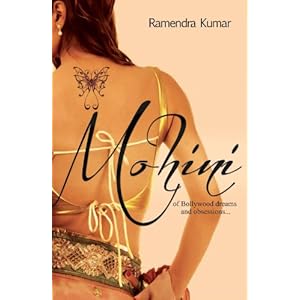
Mohini: of Bollywood Dreams and Obsessions

Ramendra Kumar  is a prolific author with several awards and twenty-three books to his credit. Best known for his many books for children, he is a regular at literary festivals and seminars in India and abroad.  

Mohini of Bollywood Dreams and ObsessionHis latest work, a pageturner saga and his first novel for adults, is about the reality and tears, the passion, intrigue and suspense, the dreams, loves and heartbreaks behind the magical world of Bollywood. Mohini of Bollywood Dreams and Obsession is a racy story of three people driven by their obsessions.

A young girl growing up in the shadow of Bollywood secretly dreams of becoming the number one star in the industry. In her ruthless, and sometimes reckless, pursuit, she uses and is used by many individuals. However, there are two men in her life who love her to absolute distraction. One she betrays, and the other she rejects. Both unleash vengeance and pit themselves against each other as the fast-paced story unfolds.

Ramen, as he is popularly known, chose to set his tale in Bollywood because "We are a film crazy nation. Every aspect of our life and living is impacted by movies.   I too  grew  up watching movies and  was hugely influenced by them. And hence, when I chose to write my first novel for adults  Bollywood was a natural choice." 

This film buff "grew up watching re-runs of  classics like Pyaasa, Jagte Raho, Chalti Ka Naam Gaadi,   Anand , Jaane bhi do yaaron,  et al. From snatches of conversation at home I came to know the buzz behind Bollywood : how a  leading  heroine dressed up as a tribal and  managed to grab the lead role in a blockbuster, how a showman turned marketing wisdom on its head to make his movie a mega hit,  how a brash  wannabe star   tried manipulating the system   in an attempt to bag the   top award of the country. All these delicious nuggets have been scattered in the pages of Mohini. Most of the rest is from my imagination."

The current crop of stars have not inspired the main characters, Ramen shares. "However, a few of  the supporting ones do bear resemblance to the stars and superstars of  recent times."

Mohini has all the elements of a Bollywood masala movie. If it is adapted for the silver screen, Ramen feels Deepika Padukone would be the perfect choice for the lead role. "She has the classic looks, the talent, the attitude and the chutzpah to essay the character to perfection," he shares, as he signs off.

Sunday, December 15, 2013

The Shadow of the Crescent Moon: Book Review

Land of Terror: The mountainous region of Waziristan, the setting of Fatima Bhutto's book. The Shadow of the Crescent Moon: Fatima Bhutto    Penguin/Viking

In this striking novel set in Pakistan’s frontier province of Waziristan, Fatima Bhutto attempts to bring to life the myriad aspects of life on opposing sides of strife. The intriguing opening draws readers into a world of apparent normalcy, a small town where the bazaars are opening to accommodate last minute Eid shoppers. Yet ominous forces cast heir shadow upon this community of ordinary people going about their daily business. The “fog makes it seem as though the tanks aren’t there at all. On the roofs of the town’s buildings, snipers lie in their nests, surrounded by sandbags.”
This is a world where religion has become politicised. People now choose their mosque carefully. “Fridays were no longer about the supplicants; they were about the message delivered to them by faithful translators of the world’s clearest religion.” Men of Pakistan’s frontier regions like Inayat and Ghazan Afridi felt that they were treated by those in power as barbarians. They knew that ‘democracy’, ‘development’, ‘reconciliation’ and ‘devolution’ were mere words, new ways used by the government to “use our own people against us.” Men like them dedicated their youth to struggling against oppression. The state began fighting its own. “Town by town, civil wars were lit by the wide-scale violence of the army — a violence that spanned decades and finally reached its zenith in the War on Terror.” Peaceful dissident professors, students and intellectuals were illegally captured by the government authorities to join the ranks of the undead, the missing, and the unknown. Or, like Azmaray, their brutalised and mutilated bodies were left on university campuses to serve as public warnings.

.... 
This novel spans the startling events of a single day in the lives of Inayat’s three sons and Ghazan Afridi’s daughter Samarra. The author deftly moves the narration back and forth, using flashbacks to trace developments in the lives of these young people striving to live and love in the throes of rebellion. Inayat’s three sons have chosen different stances on the ongoing conflict in their homeland. The eldest, Aman Erum’s quest for “success, comfort, respect” and freedom from the restrictions of life in a small border town leads him to sell his soul as an informant to Colonel Tarik of the Pakistani intelligence. In exchange for a passage to the US to seek a coveted foreign degree, he makes the deal himself, eagerly dropping “his country like a weight off his back.” He sacrifices and later betrays his childhood sweetheart Samarra, who becomes the object of the youngest brother Hayat’s affection. Samarra and Hayat take on the burden of their fathers’ struggle to free their homeland. These two idealists face danger, disenchantment and pain. Aman Erum’s second brother Sikandar chooses the middle path as a doctor striving to practice the profession of peaceful healing in his ravaged homeland. Yet violence overwhelms him, snatching his young son in an act of terror.

The author tells their stories in polished prose. Some memorable passages bring to vivid life the characters and their world. We feel for the characters and can understand, if not always agree with, their actions and motivations. However, one wishes also to know them better, to get more glimpses of their inner lives. We could, for example, look deeper into Sikandar’s love for his son and wife, and the reasons for his staying on in his homeland, while many of his colleagues migrated abroad.


Samarra is a strong and memorable character; the tomboy who evolves into a beautiful, confident and complex young woman capable of powerful emotions. Sikandar’s wife Mina, in contrast, is quite flat. Crazed by the loss of her child, she goes to the funerals of strangers, hoping to understand her loss. The older women, Malalai and Zainab, are also one-dimensional, quietly coping and keeping the home fires burning in the background. Colonel Tarik and the Taliban leader, who intercepts Sikandar on a mission of healing, have immense potential. As the novel stands, we get only the briefest glimpses of them. Explorations of the mind behind the spy kingpin’s hand that turns the wedding band on his finger as he recruits traitors and tortures innocents, would enrich the narrative. The Taliban leader lets Sikandar and Mina go, when Mina’s hysterical rants remind him of his role in the misdirected attack which killed Mina’s child. Delving into the human side of a hardcore extremist would offer another unique perspective on the many facets of war and violence.

This review is published in Sunday Herald


Sunday, December 08, 2013

Nazi Goreng by Marco Ferrarese; book review

Association with Kitaab, an exhaustive website on Asian writing in English, gives me the opportunity to read books from other Asian countries which are not accessible in India. Marco Ferrarese' racy novel Nazi Goreng gave me ringside view of the world of young Malay fanatic skinheads.

This exciting and engrossing novel explores racial animosity and urban crime. Steeped in local colour, this very Malaysian story has wider relevance in today’s world of the global village. Urban conglomerates the world over are rapidly becoming cultural melting pots. People are migrating to far corners of their country and abroad in search of a better job and life. This trend can heighten the insecurity of indigenous populations, who feel threatened as they perceive outsiders to be vying with them for finite resources and jobs. Urban crime and racial tensions are the inevitable result.

Foreigners migrate to Malaysia in search of a better life. Even educated people like Ngoc and her friends leave their home in Vietnam.   The math is simple but compelling. In a corporate office in Vietnam, Ngoc ‘s university degree in Economics will fetch her only half the pay that she earns as a waitress in Malaysia.  The author perceives Malaysia’s multi-racial and multicultural society as akin to the wholesome local dish, nasi goreng, which is a delicious mix of varied and nutritious ingredients. The book’s title is a play on this, and the racial bigotry which can ruin the beautiful cultural symphony.
In Nazi Goreng, the author skilfully draws us into the story of small-town boy Asrul’s metamorphosis from innocent victim of street violence, to a neo-Nazi skinhead out to brutalize foreign immigrants, who is sucked into Malaysia’s underworld of drug trafficking and crime. ...

The author brings the setting to life. From the underground heavy metal music movements to the criminal underworld, to the world of poor working class immigrants, the details and descriptions are vivid. At some places though, the descriptions are overdone. “Mr Porthaksh came closer and they could see his face more clearly as the shadows were erased by the lamp’s rays, forced to retract into his pores like mad vampires escaping the sun’s light.” Elsewhere in the same overdone vein, “ his Adam’s apple rock(ed) up and down like a horse with rabies.”
The plot is well-crafted, tracing Asrul’s metamorphosis into a hardened criminal, and the exciting climax. There are a few parts though, which could have been smoothened out. For example, it is implausible and awkward that drug dealer Tan Moe and his moll Siti take several pages to explain their operations to the captive Asrul.
On the whole, this is an interesting and racy read, which will appeal to readers everywhere.

My detailed review is published in Kitaab

Friday, December 06, 2013

The world of Santhals: Hansda Sowvendra Shekhar's debut novel

I've had the pleasure of knowing Hansda Sowvendra Shekhar virtually, and his thoughtful comments and messages stood out amid the clutter and inanity which can fog Facebook. A medical doctor by profession HSS, as we call him, has created the time and space in his busy life to craft which is probably the first novel in English to explore the world of Santhals from within. The novel is due soon from Aleph, and promises to be an exciting read.

HSS shares how the novel happened.
" I got the idea for this novel from an incident which happened in my village. I took hints from village gossip and from the stories and incidents my pishi told me. My pishi who's raised me told me a number of stories and I've also included some of them in my book. There are political events too, to give the story a certain time frame. The info for this I got from my father and my Hopon-daadu (Chhoto-daadu, my grandfather's younger brother). My novel is full of Santhali folklore and songs and rituals and everything that happens in a Santhal village in my part of Jharkhand: the East Singbhum (Purbi Singbhum) district; more specifically the Chakulia and Ghatsila blocks of East Singbhum district. I got many other details from other members of my family, like my other pishi. Since it all comes from me and my family, one can be pretty sure it's authentic Santhali material and not some exotic stuff."

Monday, December 02, 2013

Crowfall; book review

Crowfall
by Shanta Gokhale
Penguin/Viking                Crowfall
2013, pp 274
499                               

This award winning novel follows a group of artistic friends who brave external pressures and personal anguish in search of creative fulfilment. Through their art, they try to come to terms with injustice, unreason and violence in the world around them. If society is to change for the better, is the power of words, the power of art, the only instrument to bring it about? Or is it sheer stupidity to expect the world to change through the artist’s vision? This finely crafted novel explores the wider significance of art, artistic freedom, and its connections with everyday life.

Mumbai is a city whose peace and orderliness is constantly threatened. This compelling narrative opens with Anima’s memories of that fateful night in January 1993, when she lost her husband to senseless communal violence. She opts to break free from the vortex of grief by destroying the journals into which she poured her emotions for over a decade. She finds fulfilment in connecting with her young students, who are like the children she could never have. Her brother Ashesh, a painter, accepts the challenge posed by accidental patches of black on his canvas. ...

Author Shanta Gokhale weaves in such touches of sharp wit and satire, which hit right on the mark, without distracting us from the main story. The narrative and dialogues flow smoothly, punctuated with memorable images. The author makes every word count, while creating vivid scenes such as that of crows falling from the sky because someone has attacked them with an airgun.

“Each time a crow fell, the others’ cries reached a crescendo. Blinded by fear and grief, they dashed against the veranda.” The circles of senseless violence continue, but there is an underlying base of hope. The characters find solace and joy in friendship and love. Feroze is excited by the prospect of creating a new masterpiece from the torn bits of his vandalised painting.

The reflections on the many aspects of art are expressed naturally through the characters and their distinctive views, without weighing down the narrative. However, the seminar on “The Many Views of Art”, organised by gallery owner Vikram Shah, seems intrusive and too obvious a device to air an ongoing philosophical debate. The speakers’ speeches run through several pages of what would be more fitting in textbooks than in a novel.

The author’s English translation from the Marathi reads like an original work in its own right. It gives us a tantalising taste of the wonderful writing happening today in our regional languages.

My detailed review is published in Sunday Herald

Sunday, November 24, 2013

Kishwar Desai, an interview

Kishwar_DesaiI recently had the pleasure of interacting with award-winning author and former print and TV journalist Kishwar Desai.
Her novel, Witness the Night (Harper Collins, India and Beautiful Books, UK, 2010) won the Costa First Novel Award and was long listed for the Man Asian Literary Prize and long listed for the DSC South Asian Literary Prize, among others. The story of social worker Simran Singh explored the issue of female foeticide and infanticide in India. It has been translated into over 25 languages.
Her critically acclaimed second book in the Simran Singh series The Origins of Love was published in June 2012. It examines the growing commercialisation of Artificial Reproductive Technology (ART). This has become a huge international business and a very exploitative industry, led by the medical profession trying to “help” infertile couples.
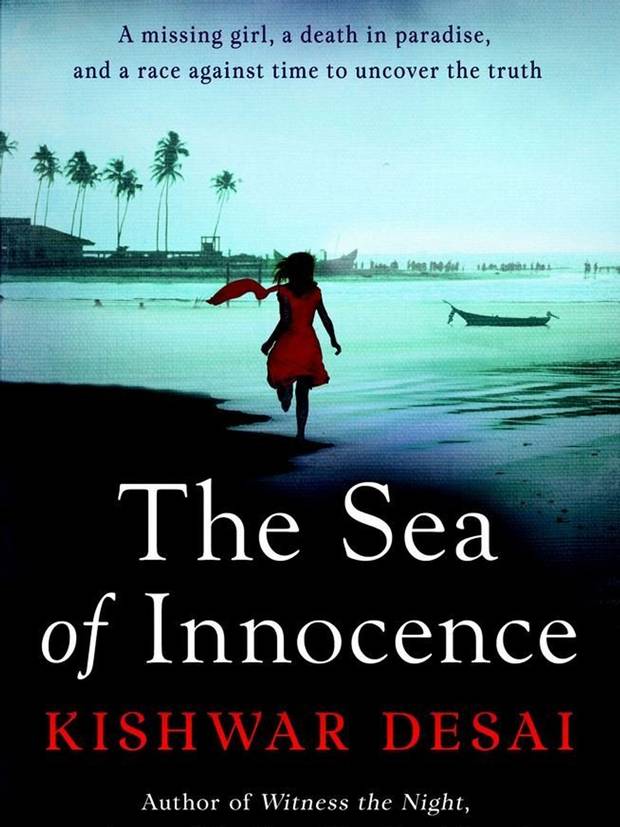
She has recently finished her third and the last book in the Simran Singh series, which is set between Goa and the UK, and deals with the brutal death of a teenager on a Goa beach.
Kishwar Desai is deeply interested in Indian cinema. She writes columns and is also a member of the Steering Committee of the International Film Festival of India. She is married to economist Meghnad Desai, a member of the British House of Lords. She lives between London, Delhi and Goa—travelling all too frequently!

Please tell us about your books; some anecdotes perhaps, of how they happened.
My first book, Darlingji: The True Love Story of Nargis and Sunil Dutt, was something my husband, Meghnad and I had discussed as a book we would do one day, together, as we are both very interested in Indian cinema. And, after we met Sunil Dutt, we even started planning it. However, very soon after, Meghnad became busy in the UK Parliament, and I ended up doing the research and writing the whole book by myself! The trilogy of novels featuring the social worker cum detective Simran Singh, on the other hand, was something I had wanted to write for a long time. Especially the first book, Witness the Night. It evolved out of a chance meeting with a woman who told me how she had survived an attempt by her family to kill her as a new-born baby. As a journalist I had written about female foeticide–but this woman’s story was so moving I wanted to make it into a film. At that time I was working in TV. So after writing Darlingji, I sat down to write a film outline for Witness the Night–and it grew and grew into a book. And then my publisher liked Simran Singh so much I was asked to write a second and a third.
...
Any pitfalls of being an attractive female writer, and being married to another famous personality?
Thanks for the compliment! I haven’t noticed any pitfalls—but then I don’t think there are any advantages either! After all, writing is very hard work—looks don’t matter! Being married to a famous author means that one can be overshadowed, and I used to be worried about that—but fortunately since my books are very different from the kind that Meghnad writes—I have managed to retain my own identity.
We live in a market economy. How has that changed writing and publishing?
Well, all authors want to write books on subjects they are passionate about. So far, it has been very good for people like me. But I can see that there is a lot of pressure now ( when we see how bestsellers have been ‘created’ and ‘sold’ in India) on writers to go out more, interact with the trade and marketing personnel—which did not happen before. Social media has also become very important. All of this is very time consuming—and I suppose writers like me who want to be a little reclusive will have to try harder to learn all these new ‘techniques’. But I still hope that ultimately if a book is good, it will sell.

The detailed interview is published in Kitaab

Tuesday, November 19, 2013

Review: Toraja: Misadventures of an Anthropologist in Sulawesi, Indonesia by Nigel Barley

toraja-jpgToraja: Misadventures of an Anthropologist in Sulawesi, Indonesia by Nigel Barley (Monsoon Books; US$ 15.95, Pp 232)
Many interesting books are being published all over the world, but only a handful make it beyond their borders to an internationals audience. Being associated with Kitaab has given me the opportunity to review foreign books which publishers and marketers may feel will not draw a huge audience outside their country of origin. But these books are interesting to readers like me, who are unfamiliar with the subject and setting. In fact, to me at least, this novelty makes the reading experience more exciting.

Toraja is a delightful account of antrhopologist Nigel Barley's sojourn into a remote and little-known region of Indonesia. The name Sulawesi, Indonesia invokes mystery and the lure of the exotic and unknown. This book offers a knowledgeable and entertaining account of an anthropologist’s journey through a remote, largely uncharted region and culture.
The author succeeds in making us laugh page after page with hilarious accounts of his travels rife with the human touch. He also offers enough insights to engage serious readers. The spontaneous flow of humour is sustained throughout the book, with only a few points where it could seem contrived. This is certainly no mean feat.
As author and anthropologist Nigel Barley states in the introduction, this book is far from a bland monograph written by an omniscient scholar. “It deals with first attempts to get to grips with a ‘new’ people – indeed a whole ‘new’ continent. It documents false trails and linguistic incompetences… Above all, it trades not in generalizations, but encounters with individuals.”
Amusing, animated descriptions fill page after page. For example, the author is compelled to stop at a hotel called the Bamboo Den, which also doubles as a language school. “It was a vision of hell. Hot, dirty, full of cockroaches so confident of their tenure that they sat on the walls and sneered at passers-by.”

...
Nothing, not even fellow anthropologists, escape the author’s witty barbs. Field work satisfies anthropologists because, among other things, “he ceases to belong to the impoverished part of the population and becomes, in relative terms, a man of wealth – the sort of man who can blow seven pence in a gesture of sheer altruism.”
The author’s observations on local culture are just as humorous, while containing a core of serious truth. He and his guide wear t-shirts with silly slogans to a Torajan funeral, not just because these are the only black clothes they have, but also because “Torajan funerals are inherently jolly occasions, at least in the later stages, for grief is long behind them. The body may well have been kept for several years while resources are mobilized and people summoned from abroad.”
Such animated descriptions are alternated with occasional comments on serious issues such as value judgements and ‘cultural prejudices’...

The wonderful thing about this book is that such serious observations are kept brief and do not weigh down the overall ebullience of the narrative. Indeed, some of these serious observations are also presented in an amusing style. “It is always slightly shocking to be in a country where Christianity is regarded as a serious religion and not a mere euphemism for godlessness.”
The author leads us in an unexpected and delightful twist, when he brings Torajans to England to build one of their elaborate rice barns in a museum. The Torajans find England as exotic and outlandish as the author found their land, and much fun happens from culture shocks.

...Overall, this is a thoroughly delightful read about a little-known, remote region of our globe. A section with the author’s own black-and-white photographs supports the text. One only wishes for more photos, and in colour. Also, little errors creep in every now and then, which could have been cleared with more careful editing.
My detailed review of this book is published here in Kitaab
...


Sunday, October 20, 2013

A Restless Wind; book review


ISBN 9789382616115 Author, Shahrukh Husain, Publisher Pan Macmillan India, Pp 360, Rs 499/-

A Restless Wind piques the reader’s interest from the very beginning with fine details and a strong and engaging protagonist. However, a restless wind blows through the closing chapters, leaving a heap of tangled threads. Hana, the ailing matriarch of the Ramzi clan of Muslim gurus to the Hindu rulers of Trivikrampur in Gujarat, knows her end is near. She needs to clear up what she can and rectify mistakes of the past before 21st-century sectarian violence ruins the age-old communal harmony of her beloved Trivikrampur. She chooses to reveal these stories she should have told long ago to her dear niece Zara, whom she summons to their family home in Qila....

The theme of communal prejudices runs through the novel, and the author explores its many aspects in a balanced manner. The opening pages introduce us to the demon of communal violence in present-day India. The armies of dispossessed, who flee for safety across boundaries of sea and land, are Zara’s clients who seek asylum in Britain. The author balances this with specific acts of goodness. Zara’s client, Parveen’s family, is massacred by communal forces in Gujarat.

Yet a Hindu auto driver guides her to safety. Other good Hindus rescue Parveen after she is raped and brutalised. Hindus like the “Swami guy” help Muslim victims of communal violence, and themselves end up as “fucking asylum seekers in the UK,” with no housing, no NASS allowance and a dog’s life. Zara sees racial and cultural prejudices everywhere among the British as well, with “hooligans chanting racist and misogynist obscenities.” Zara comes home to Quila to find its walls charred by arsonists protesting against “the Ramzi-Vamana bond and the blurring of religious boundaries,” dating back to the legends of the Green-clad Man, who founded the Ramzi clan.

The first half of the novel leads us to expect further exploration of the inner life of Zara and other major characters and the intricate dynamics of communal harmony and disharmony in India. However, the latter half of the novel overwhelms with a profusion of new characters and sub-plots. Hana dies before revealing her secrets to Zara, who resolves to uncover them on her own. We are rapidly introduced to Zara’s cousin Saif, the spiritual head of the Ramzi clan, his wife the peevish and suspicious Pebbles, their mentally-challenged daughter Sharmeen and her cousin and lover Kamran.

 Things happen so fast, that we do not learn enough of their true feelings. We are told, for example, that Pebbles and Saif are deeply in love. Yet Pebbles plans a shopping spree for her daughter’s trousseau just after his sudden death. Did Aunty Hana really alienate Zara from her mother, while professing to love her? Dilkash’s demented narration of Nyla’s past is one example of too obvious and expedient a plot device.

Too many things involving too many people happen simultaneously in the latter half of the novel. Each of these many subplots is potential Bollywood material. As things stand however, they give the impression of outlines rather than fully fleshed out characters and their stories. There are mysteries galore with Sita Devi and her strained relations with Hana, who were formerly like sisters. Sita Devi hints that her son Jay and Zara may share the same father, making Zara cool off toward her former lover.
In sum, this book begins on an interesting and exciting note, but towards the latter half, the multiple characters and their stories get entangled into a confused heap. There are passages of fine writing and character delineations, but the momentum and focus gets diffused toward the end.

My detailed review is published in Sunday Herald

Wednesday, October 09, 2013

Heroes around us


In the good old days, our heroes were towering personalities such as Sardar Patel, who focused on strengthening our newborn nation with single-minded conviction. Gandhiji inspired us through a non-violent revolution, wanting the bare minimum for his personal needs, and striving for everything worthwhile for his fellow Indians. Gandhiji was a simple man, yet he heroically brought the mighty British Empire to its knees. Their followers have since gone the way of dodos and dinosaurs. New breeds of heroes have evolved, taking their hallowed predecessors’ ideals to fresh and previously unimagined directions.

Humanity has always needed heroes as role models to guide their lives. Our heroes are changing along with our value systems. The primary aim of Indians today is to somehow make as much money as possible. Everyone worships money, from government officials drooling over bribes, to private manufacturers pushing shoddy products with deceptive advertising and indifferent customer service.  Scamsters are today’s heroes, because they make the most money. They pursue this aim with the single-minded devotion of the heroes of yesteryear, striving to excel as faster, stronger and bigger crooks. Our leaders of yore preached the equality of all, irrespective of caste or creed. Modern scamsters treat Peter, Shanta Bai, the government or Rahim equally, for they see everyone as suckers to be duped. Nothing matters as long as their Swiss bank accounts fill up.

No wonder, so many of our netas who lead the nation have also been involved in colossal scams! The more prominent and powerful the neta, the bigger the alleged scam that temporarily knocks him out of action. These scam-tainted netas have the die-hard determination and resilience of a Sardar Patel or Gandhiji. No ignominy can suppress their invincible spirit. They return to contest elections, reclaim their gaddis, and set an example of courageous determination before the aam aadmi. A hero deliberately and bravely overcomes hurdles without regard to personal consequences. Scam-tainted netas are true heroes and leaders, for they brave all odds to pull off mighty scams. True heroes are selfless people who strive for the good of others. Today’s monstrous scams benefit many. After all, the loot is shared with sundry kinsmen, chamchas, and their neighbours and in-laws. Jai ho, heroic, die-hard scammies!
What’s the use of heroism, if nobody notices, or forgets in nanoseconds? A new breed of popular role models are perfecting the art of being constantly seen and heard, even though we aren’t quite sure why they deserve to hog the limelight. Glamorous fashion models, Bollywood stars, meteoric stars, wannabe stars and other motley celebs are another category of heroes perfect for our times. What makes them so wildly popular?

Well, most of us are mediocre, and we relate best with our own kind. We may pay lip-service to the Sardar Patels and Gandhijis. But we know that it’s next to impossible to reach their sky-high standards. We adore glamour because flaunting expensive possessions and slathering cosmetics can make us, our milkman, and our domestic help glamorous too. Even if we don’t win the Miss Solar System or Mr Asteroid Belt title, we can still aspire to be Miss Palace Guttahalli or Mr Kalasipalya and flash our booty on Page 3. The film industry can make a hero out of anyone. Filmmakers have absolute power to make their world of fantasy seem real. Film actors, who are ordinary people, become heroes of this fantasy world created by the imagination. Glamour, therefore, is an egalitarian and accessible aspiration for anyone and everyone, in the best traditions of Gandhian philosophy.
...
Fake show and empty-vessel hoo-ha dominates our world. Yet a few Indians continue to do their best and make a difference despite setbacks. They do the right thing, shoulder responsibility, and facilitate change without making a show, because it comes to them naturally. Real heroes of today are upright and sincere people like Dr Verghese Kurien, who strived against vested interests and organised the milk co-operatives in Gujarat into the iconic AMUL. From being deficient, India is now the world’s largest producer of milk. ...

Why do the names and achievements of such modern heroes flicker so briefly in the public eye before being eclipsed by the screaming glamour brigade? Simple. Their unassuming, unglamorous personalities cannot promote toothpastes, piles ointments or other commercial products. How will the media afford to give them more visibility, if they cannot earn enough ad revenue to sustain the hoopla? As shopaholic consumers, we perpetuate this trend. We feel that by owning products advertised, we can be like the glamorous people glorified in zillions of ads. We try to escape from our mediocrity by becoming ‘heroic’ through the cult of consumerism. It’s easier to buy stuff with that ‘feel-good factor’ instead of struggling to genuinely excel at anything.

Another reason why true achievers with bona fide credentials do not always get the appreciation they deserve is because they make us uneasy at a deeper level. Sincere people who naturally strive for excellence without hankering for publicity are constant reminders of high standards which we may never be able to reach. Rather than follow their example and drive ourselves to excel, we try to ignore them. We usually praise them with brief obituaries only after death, when they are no longer able to make us feel inadequate and guilty by their superior presence.

If we look past superficial glamour, we will find true heroes all around us, among ordinary people. These heroes have human imperfections, but they rise above difficulties to accomplish something positive. They are not showy, but have the quiet courage to do the right thing. They have the mental and moral strength to face adversities, and fearlessly walk the talk. Haven’t we all, at some stage, benefitted from the depth, knowledge and generosity of a parent, teacher, friend or mentor? It’s time we stepped forward to encourage such unassuming heroes, and to make a conscious choice to support the right values. In this way, we can spread courage and support those around us as we face the trials of life. Each of us can be a brave hero by becoming disciplined and resolute in our own hearts. It’s true that we can’t all save the world, but each of us can show bravery by standing up for our principles. True heroism is to be genuine, to quietly and firmly persist in doing the right thing despite opposition or taunts from others.

Read my entire essay published in Sunday Herald

Monday, September 23, 2013

Book Review: What the River Washed Away


Sometimes, a novel with an agenda can be a great read too, like this one by Muriel Mharie Macleod.
Louisiana in the beginning of 20th century US is no place for brave spirits like Arletta Johnson, a black girl who is compelled to escape the land of her birth and seek a life of freedom and dignity as a missionary in Africa.
They may no longer legally be slaves to white men, but even the government is ambiguous about black welfare. Arletta’s mother Mambo notes “how they used to stop us blacks having any schooling all ‘cause they didn’t think we were up to being educated and how now they’re telling us we gotta go.”

National and world politics play out in the backdrop, but life for poor blacks like Arletta remains miserable as ever. As Mambo observes with earthy wisdom, “ain’t no white folk ever share nothing with any of us.” Jobs are hard for blacks to come by, with white people accusing blacks of trying to escape military service, “like we ain’t got no right to be getting on the same as anybody else.” ...

The author does an amazing job of bringing the world of black people in early 20th century Louisiana to vivid life. Her accuracy and empathy for the characters is even more striking since she herself was born and brought up in remote Scotland, and has no direct link with the culture she portrays so well. This novel would be engaging and illuminating enough as a historical tale. However, Arletta’s journey of regaining her life and dignity takes on even broader and more timeless implications because of the underlying theme of child sexual abuse.

One drawback of this novel is that major characters are either angels or baddies, without enough shades of gray. Arletta wins our admiration for her courage, generosity and resolve. However, she also seems too good to be true. She readily forgives her mother for her past neglect and insensitivity. She reconciles too easily with her mother’s new partner, Quince, and showers her little stepsister with undiluted love. There’s no hint of regret or jealousy for the love and security, which the stepsister enjoys, and which was denied to Arletta.

Pappy hovers in the background as the departed wise and loving grandfather cum guardian angel. Mr MacIntyre and Mr Seymour are archetypal white villains, who ruthlessly prey on innocent little girls for their perverted sexual gratification. They are straw-stuffed effigies who deserve to be burnt, and they don’t have a shred of a saving grace or human quality between them. In contrast, Arletta’s landlady Mrs Archer-Laing, is a benign white do-gooder and champion of black equality.

Some of these one-dimensional characters have implausible turnarounds, which seem more for the sake of conveniently wrapping up the story. Mambo’s metamorphosis from negligent and insensitive mother to a loving champion for Arletta’s cause, is unconvincing. Equally incredible is Quince’s change from a good-for-nothing philanderer to a responsible partner and loving father and stepfather.

That being said, Arletta’s courageous story holds our attention till the end. Her world is brought home to us with memorable descriptions and lifelike dialogues, and the plight of sexually abused young girls is vividly portrayed to move the hardest hearts.


Tuesday, September 03, 2013

A Fort of Nine Towers: book review

FortofNineTowersA Fort of Nine Towers by Qais Akbar Omar (Picador UK; 14.99 Pounds; Rs 599, Pp 396)
Qais Akbar Omar was born in an Afghanistan where “our neighbours were like us, quiet and educated people. When there was a wedding or engagement party in one of their houses, everyone in the neighbourhood was invited, along with their kids and servants.”
This remarkable memoir brings to life a complex and at times strikingly beautiful Afghanistan beyond the news clips of war and violence the rest of the world has seen since decades. The author remembers the society of his early childhood as warm and benign. As a respected citizen without any elected position, young Omar’s grandfather talked after prayers at the mosque on how to keep the neighbourhood clean, solve civic problems, and create better facilities for the children to play together. People listened to him, and he discreetly helped neighbours in financial straits....
This memoir is structured around contrasts. As the author, now a young man living in post-war Afghanistan, begins telling his story, a phone call reminds him of his aunt who emigrated to Canada during the war. The aunt is searching for a bride for him, among expatriate Afghan girls who have become young women in a free and peaceful country. She has “seen them taking full advantage of opportunities they would never have had in Kabul had their families stayed there over the past three decades.” The author is now twenty-nine years old, has a university degree and runs his own carpet business. He also has both arms and legs, all of which is normal in most parts of the world, but “which is an issue in mine-ridden Afghanistan.”
As young Omar grows up, he sees his idyllic world crumble around him with a child’s innocent bewilderment. When the Mujahedin arrive in Kabul, people all over town come out to chant ‘Allah-hu-Akbar” to welcome the ‘holy warriors’. As Omar’s father explains, people “want the Mujahedin to come to Kabul and make the Russians leave Afghanistan.” Meanwhile, Omar’s sister tries to scare him by saying this chanting is the beginning of Doomsday. Little Omar is not sure whom to believe. Like the children, the adults too are innocent and full of hope. Ironically, it is the children’s innocently voiced fear which proves true. Soon, war spreads to Omar’ own neighbourhood. Mujahedin break into their home and loot their valuable carpets. Omar’ observations, rife with a child’s innocence and clarity, drive home difficult truths. “Suddenly, I understood that these guys were ordinary thieves who had joined one of the factions. They were not true Mujahedin who defend their country and faith against the invaders and heretics.” The new intruders lose no time in ravaging a lovely and peaceful neighbourhood into a war zone.
...This is a moving account of love, determination and survival against terrible odds. The author portrays the richness and beauty of Afghan life and culture with love and respect. He voices with clarity and dignity, deep pain at that has happened to his family and to his country. While demonstrating the strength, generosity and deep seated values of his people, he successfully transcends barriers with the universal hope for peace and amity.
This is a truly moving book, a must-read. My detailed review is published in Kitaab

Monday, August 26, 2013

Homeland and Beyond

  As we celebrate the 66th anniversary of India’s Independence, many of our compatriots are clamouring for divided identities. The issue of separate statehood for Telangana has reached a feverish pitch, giving a boost to similar demands elsewhere in the country. The cry for Bodoland has resurfaced, Gorkha Janamukti Morcha supporters are calling for a separate Gorkhaland, while the Codava National Council is gearing to press for an autonomous Codava Land. Will the call for a division of Uttar Pradesh build up? When everyone and their neighbours seem to be staking their claim for distinct identities, where will we stand as Indians? Will we support increasingly narrowing sub-divisions and fight among ourselves for shrinking patches of home turf? Or, shall we transcend constricted allegiances and boundaries to become not only Indians, but true citizens of the world? What defines a homeland? Is it ethnicity, language, religion, customs and beliefs? Are we Indians simply because we happened to have been born as citizens of this sovereign republic? Deep inside, do we identify ourselves more strongly as Kannadigas, Punjabis or Marathis, or according to our religious affinities? Where do we really belong?

In recent times, humanity has made rapid strides towards a global community. Yet, today, Indians are flying to foreign shores in droves, not always to open themselves to other cultures, but often to cocoon themselves within ‘little Indias’ overseas. Many prefer seeking out others from their own community and linguistic groups instead of mingling with the locals. Even within the boundaries of our own country, we prefer to associate with members of our own religious and linguistic communities. This can often happen at the exclusion of other groups.

Read my take in full in Sunday Herald

Thursday, August 15, 2013

The Geo Drama, inside story

Today we celibrate India's Independence Day. Jai Hind!

Writers crave independence too, in their very own way. They do need the freedom and space to write, to be free from financial burdens and the muddled mess of the world.
Prominent magazines fold up every now and then, leaving faithful readers, and writers and staff, high and dry. Writing is, at best, a precarious existence. Many 'creative writers' focus their energies on writing magazine features, ad copy, brochures etc.  A handful of writers puruse their true passion, writing original novels and stories. There's nothing in it financially for most authors. Ocassional messages from delighted readers are the the author's sole reward. Gigs with magazines, tech writing, etc are often such passionate storytellers' sole lifeline to roti, kapda aur makaan. They slog away at such not-really-that-creative, but much more routine jobs, to find some space to write their original stories.

 People often accost us only to wheedle out free copies of our books. Fact is, we are not born into wealth, and we are rarely appreciated for puruing our creative interests despite all uncertainties and odds.


Payal Dhar, who has written several spellbinding novels to date, has been among those summarily cast aside when Geo magazine recently folded up. She "Decided there was no point festering, so I'd just write about it:"

Here's her take:http://writeside.net/scratchpad/what-happened-at-geo

Tuesday, August 06, 2013

College Street, Kolkata coffee break

The first time I visited Kolkata's book street, it was a voyage of discovery. The maze of bookstalls, iconic educational institutions and blasts from the city's colonial past threw up startling surprises and a few disappointments.

A busy road lined with miles of bookstalls

I revisited Boi Para recently, this time in the company of someone who grew up there, and is now guiding young minds. Dr. Sandipan Sen belongs to that uncommon breed of scholars, who revel in delving into interesting but little-known facts. If it weren't for individuals like them, so many facts and details would be glossed over by those out to simplify everything into easily digested bytes. such scholars enrich our collective knowledge and strive to keep public memory alive. Are people like him out to show off their learning and dazzle others? Not at all. Dr Sen is low-key and unassuming, and the twinkle in their eyes makes one suspect that they hide much more knowledge than they are ready to flash before others. In fact, such people merely point out omissions and errors which many others would have missed. The idea is to be true to facts and get the right perspective. This is necessary, or people would be making errors unwittingly, or even deliberately misrepresent facts to misguide others.
David Hare's tomb, relic from the Raj


"Bankim Chandra had once lamented that Bengalis do not care for history," he shares. "This is once again evident when we see that a film has been released, titled "Bombay Talkies", which is purported to be a tribute to the father of the Indian cinema, Dadasaheb Falke, on the centenary year of Indian cinema - because Indians have accepted the claim, made by the Mumbai lobby, that dadasaheb Falke had made the fir...st film in India. And, alas, no one remembers - not even any Bengali does - that the true father of Indian cinema was not Dadasaheb Falke, but Hiralal Sen, who made his first film, "A Dancing Scene", and made several more feature films between 1901 and 1913. Not only that, he produced India's first ad film - on Jabakusum Hair Oil, and he also made India's first political film - an anti-partition film which was shown in the Albert Hall in September 1905. He also founded the first film company in India - the Royal Bioscope Company. Everyone has managed to forget Hiralal Sen, and now we treat Dadasaheb Falke as the first Indian film-maker - though his first film, "Raja Harishchandra" was made only in 1913 - the year in which Hiralal Sen had made his last film!
Bankim was right. We don't care for history. Nirad C. was right too - we are a self-forgetting people."

Albert Hall coffee house with Dr Sandipan Sen
His advice was very helpful when I was writing my biography of Rabindranath Tagore for young people. I wanted to thank him in person when I visited Kolkata. There we are, in the iconic Albert Hall coffee house in College street. Dr Sen was once among the students here, who gather to discuss books and everything else under the sun. Our wizened waiter knew his patron from his college days, and the atmosphere buzzed with life.


Dr Sen enjoys sharing unusual nuggets of little-known information. Here's a sample from his stores:

 "He used to earn Rs 60,000 a year from his paternal property, which allowed him to save Rs 50,000 a year, because - in spite of his lavish lifestyle - his annual spending was not more than Rs 10,000. However, despite having such a huge income, he accepted the job of a petty Sereshtadar which carried a paltry pay of Rs 150 per month. Why did he do so? Simple, after six years of service, he could amass Rs 12 lakhs from this job, which was the initial capital of the Union Bank!! Rs 12 lakhs in only six years with an income of Rs 150 per month? Impossible, you would say? Yes, arithmetically so, but not practically, because there was no bar in those days for the government officials to pursue independent business ventures, and he did that - and did successfully by exploiting his official position (in those days people had scant regard for moral laws, his grandfather turned rich by becoming a Thikadar for the almost-never-ending project of building the new Fort William in Calcutta - a project from which everyone grew rich)!!

So, he had his own reason to look for a government job carrying a meagre salary compared to his huge income - because that allowed him to earn even more money by exploiting his official position. And he is called the first "Udyogpati" (entrepreneur) of Bengal!!

My idea about entrepreneurs and about how people grow rich became even stronger with these facts about Prince Dwarkanath Tagore, who turned so rich that he could spend Rs One Lakh in a month during his stay in London!!

Truly, even if a camel can pass through the eye of a needle, a rich man cannot go to the kingdom of God, as famously enshrined in the Bible. Because the way to money is not fair, as we understand from this example."


Photo: The first Indian to be seated along with the head of the state of a foreign country during the Army Review Ceremony (equivalent to March Past) of that country. "Prince" Dwarkanath Tagore. In Great Britain. It was on 23 June 1842.
Raja Ram Mohun Roy
Bankim Chandra Chattopadhyay
  
Here's some more: "The first Indian to be seated along with the head of the state of a foreign country during the Army Review Ceremony (equivalent to March Past) of that country. "Prince" Dwarkanath Tagore. In Great Britain. It was on 23 June 1842. "

From Albert Hall coffee house, Dr Sen led us through a maze of by-lanes into amazing world of subaltern intellectuals, who continue to flourish in the nooks of College Street. Not for them the mainstream business of textbooks, guide books and pulp bestsellers. Niche specialists here lovingly compile and propagate storehouses of information on less-known but interesting esoteric topics.
Winding our way through rows of homes, printing presses and even more bookstores, we arrived at a store with books lining the antique show window. Anil-da greeted us from his desk polished well with years of use. Prof Anil Acharya, the editor of Anustup, writes and publishes on esoteric aspects of Kolkata's rich and varied culture. What was the city like in the times of great intellectuals and reformers such as Raja Ram Mohun Roy and Bankim Chandra? Prof Acharya will pull out scholarly books to satisfy your curiosity.

Prof Acharya was Dr Sen's former teacher, and the two share great chemistry. Their eyes twinkled with flashes of subtle wit as they discussed the alternative literature produced by Kolkata's Bot tola indigenous presses of yore. Did you know that people from the Marwar region of Rajasthan spread to Bengal centuries ago as they expanded their business and trade networks. Over time, they blended with the local culture while maintaining a distinctive identity. They have thrived in Kolkata for centuries.  You'll learn all this and more from the books Prof Acharya champions.

These scholars who enjoy learning for its own sake, don't always have their heads lost in the clouds. A gentle nod from Prof Acharya signalled a wizened mashi to enter with steaming cups of tea. Endless freewheeling addas over coffee and tea is one of the many charms of College Street.