Creativity is allowing yourself to make mistakes. Art is knowing which ones to keep. Musings from someone who sees stories everywhere.

Sunday, May 27, 2007

swinging into the sixties


Life begins at 60 for veteran journalist and author Kalpana Sharma. A widely respected senior journalist with The Hindu, Kalpana's column on gender issues has a nationwide fan following. Kalpana is looking forward to a life of new freedom as she retires as the Mumbai bureau chief of The Hindu at the end of
May.

This fiesty lady, who looks not a day over forty says," I'm not retiring from journalism. I'll always remain a
journalist. And am looking forward to starting my career as an independent
journalist."

She shared her thoughts in a friendly get-together with twenty of us Network of Women in Media Bangalore members on
Tuesday, May 22, at a cozy little cafe. "Being sixty is a landmark but also just another year
in the life of a journalist who can't stop being one!" she told us amid rounds of applause.


It was a cozy and cheerful affair, the gang of ladies wishing Kalpana a happy birthday and a long innings ahead.

We had a lot to learn as we listened to Kalpana's recollections of a 34-year-old
career that began at 'Himmat' That small but respected magazine stood up to the Emergency of the Seventies and press censorship. And in those dark days of modern Indian history, even major, "mainstream" newspapers
bent before the powers that be.

"We experienced first hand the pressures and pulls
of State oppression," she reminisced.

Kalpana is a born mentor, and she aims to have more time to spare for budding scribes in the days ahead. "When we
started out at Himmat, our seniors took time out to train us," she said,
She also plans to update her book on Dharavi and quite naturally has more
book ideas in the pipeline. Interestingly, she also wants to catch up with the people about whom she wrote in her famous 'Gender Perspective'column, and follow up the case studies.

Best of all, this eminent journalist is a well-rounded personality with a cheery smile and a hearty laugh. Age can never wither this evergreen lady. She's off on a lecture tour in berkley before returning to
Mumbai.

"Now skepticism is reducing," Kalpana said. She feels that routine news reports are becoming more common these days. People don't always stop to ask deeper questions. She encourages young journalists to probe further, do full justice to the subject and refrain from sensational reporting. "Even the camera can be manipulated...sensational old footage can be shown." She is totally against "opinion being manufactured."

Things like SMS polls, so popular with the media today, gives the opinons of a small, unrepresentative section of society, she feels.

We celebrate this lady's 'coming of age' as an independent journalist. While infusing her circle with life and verve, may she continue to keep an eagle eye on the media and see that it fulfils its role as watchdog.

Monday, April 16, 2007

returning to an old friend


Some books form a personal connection with me. One of these is Gabriel Garcia Marquez's One Hundred Years of Solitude. I picked up my copy after several years and remembered my dear friend Maria from Spain, who had sung praises of this bible for Spanish readers. The dog-eared bookmark with Maria's fading handwriting, exchanging personal impressions as we discussed my progress through the book, the soft focus sepia tinted memories returned.

"Many years later, as he faced the firing squad, Colonel Aureliano Buendía was to remember that distant afternoon when his father took him to discover ice." Thus begins One Hundred Years of Solitude, from a terrifying point in the distant future, where the firing squad is preparing to shoot to kill. Dream and memory whirl into a heady mix to draw the reader into a narrative where time moves in many directions at once. This matter of fact yet incredibly farfetched note typifies the essence of Magic Realism.

I entered Macondo again. Staying awake till the early hours, I joined the villagers of Macondo as an insomnia epidemic threatened to erase all layers of culture and identity. I witnessed "the precise moment when Aureliano Babilonia would finish deciphering the parchments, and that everything written on them was unrepeatable since time immemorial and forevermore, because races condemned to one hundred years of solitude did not have a second opportunity on earth."


One of the world’s most famous modern-day classics, One Hundred Years of Solitude encompasses in its epic sweep the history of the Buendia family. A mix of the political, emotional and magical, this novel is among the best known and most popular novels in the tradition of Magic Realism. This novel has been translated into many languages including English, and has sold over 30 million copies worldwide. It portrays the history of Macondo on a larger-than-life level, tracing events from its mythic foundation to its final disappearance. A middle-class family chronicle set against the backdrop of Latin American history, this novel tests the boundaries of narrative fiction. Garcia Marquez once said that he seeks to bring out “the magic in commonplace events.” The events in the novel may seem fantastic, but much of it has a solid grounding in reality. The massacre of hundreds of banana plantation workers in the novel is based upon an actual strike by workers against the United Fruit Company in 1928.

Thursday, April 05, 2007

pearls in writers' groups


My writer friend Behlor Santi says, "I returned to my old stomping grounds...There's a lot more coffeeshops and bars and boutiques there. There's plenty for the tourists. Yet I felt that I'm returned to the same bullshit,...looking the exact same way they did in 2002. Back then, I was in a more fragile emotional state, and I yearned for these hipsters' approval. Not, I laugh at them. I notice how pathetically they lie, how cheesy and classless they are. ...To artists everywhere else--I ask you this: do you feel alone in a sea of poseurs? Or have you found solidarity with fellow artists who create the real deal?"


Yes, I also feel alone in a sea of poseurs sometimes. And then I see that I, too, am a poseur, pretending not to care about so many things like rejection slips, comments in shrill voices punctuated with raised eyebrows like "Oh, so YOU wrote that article in yesterday's paper? I read the one next to it and it was really interesting. But yours, ..." Or, "You sure do have a lot of idle time on your hands."

And I pretend not to care when someone welcomes me in a new on-line writer's group and the thread is immediately hijacked to a completely unconnected topic. (That's happened to me thrice)

But then I do find solidarity in this sea of, well maybe not poseurs but but people who couldn't give a damn. Because of people like you who drop by at this blog. Because we sift through the sand and eventually do find lovely sea shells and even pearls.

Sunday, April 01, 2007

Fooling around


It's April Fool's Day. What better way to celebrate than fool around on my blog? Fooling isn't something to be lightly dismissed. It's serious business, the breeding ground for creative thought. Would Issac Newton have thought of gravity while chopping wood, labouring in the farm or getting traumatised at the dentists? Quite unlikely. If an apple fell on his head while he was washing his car, he would probably have cussed,kicked the apple into the gutter, and gone to put an ice pack on his aching head.

For those professional fools, the clowns, fooling around is serious business. Their comic style varies, from witty, loaded quips to being just plain slapstick silly. There are sad clowns and there are scary clowns just as there are enough people who are afraid to laugh and unwind.

And me? I laugh most to combat stress. When overwhelmed by adversities, I've seen people take a brief, lighthearted break. Laush in privacy at the things and situations that seem msot daunting, and you've made them surmoutnable and won half the battle. A hearty laugh helps put things in perspective before getting down to business again.

Tuesday, March 27, 2007

Not yet dead


'Lost for words, blog craze dying' cried out the headline inside today's Times of India. An estimated 200 million (whoa!) blogs have been started and then abandoned, creating the internet's fastest growing graveyard. Millions of bloggers have nothing left to say.

But hey, I'm not yet dead. If I've been away for a few weeks, its not because of lack of ideas. Sometimes life overwhelms us. Running around in circles to untangle growing messes has left me little time to express myself here.


I'm still full of ideas as is the serious blogging world. Bloggers can and do continue to make a difference. Do check out the Wandering Author's blog. His latest post is a call to help children who cannot speak. And he offers an innovative and interesting way to raise funds to help victims of apraxia, which deprives sufferers of the ability to speak.

And that's the best way to lift yourself out of self pity and self-indulgence. Get out there and lend a helping hand.

Saturday, February 17, 2007

Bitter or Timid?


It's uncanny how heartfelt words from a great writer can guide one's thoughts away from musty, cobweb-infested niches toward fresh air and clear skies.

Some years ago, Salman Rushdie's detractors set a price upon his head and forced him into hiding. In continuing to write, Rushdie has overcome "two traps set by the fatwa: writing timid novels and writing bitter ones." He says, “If somebody's trying to shut you up, sing louder and, if possible, better. My experience just made me all the more determined to write the very best books I could find it in myself to write." Rushdie continues to strive for greater literary heights, and he draws us into his world of consummate artistry.


Few can hope to match Rushdie's intellect and talent. But we too can try to face setbacks and overcome them. When a nameless little stream is stopped by a row of boulders, it can sink into a stagnant pool and let slime and insects breed in its once clear water. Or it can gush over the barrier and flow on, bubbling over and singing its cheerful song on the way.

Thursday, December 28, 2006

Publicizing yourself?

Self-publishing? Utter those words in any writers' group and poison pens will launch an assault against errant word-processors. Those rare specimens who have 'successfully' been published by commercial publishing houses will turn up the snootiest noses at plebians with piles of rejection notes. And a brave few will vow to have those very rejection slips bound and ready to sell. So what if they pay for the privilege?

While commercially published writers are most definitely accomplished and successful, it would be wrong to dismiss everyone else with a flair for a well-turned phrase.

The fact is, agents and publishers will actually support a few books which make commercially viable sense. If a work or writer has market potential, then there's a ready to advertise and market product.
Such books will definitely have their literary and technical merits. But for each book actually published, there will be many more talented writers with original and well crafted manuscripts whose writing never makes it to the bookstore shelves.

Struggling against the tsunami of commercial validation, our local writers' workshop, Katha Lok, brought out a collection of short stories by members. 'Many Rooms Many Voices' was a collective effort, with writers contributing an affordable sum per published story. We battled shyness and worked together to host book reading sessions in local bookstores, and to have group photo sessions, interviews and reviews with newspapers and magazines.

We tried our best and got encouraging feedback. Yet as simple individual writers, we could not sustain a long term publicity drive. If we spent all our limited time and resources to warm up the market, when would we write?

I still retain a sizeable portion of my personal copies of our book. I never made a profit from my modest initial investment in the venture. Yet all is not lost. A couple of days ago, several years after its publication, I spotted our book in a stall. I don't know how or why it had been placed there among all the fast moving best sellers. We never became rich or famous. But it's heartening to note that readers are still leafing through and perhaps buying our book.

Wednesday, December 27, 2006

Reading wishlist, 2007


Curling up with interesting books is a great way to settle into the new year . Browsing through the racks, I choose 'Alentejo Blue' by Monica Ali, 'Beasts of No Nation' by Uzodinma Iweala, 'Gate of the Sun' by Elias Khoury (available in a recent English translation), and 'Absurdistan' by Gary Shteyngart.


Fiction can enhance our understanding of the human experience in deeper ways. When we read a well crafted story by a master of the written word, we are led into sharing the lives and thoughts of people in distant lands. Sometimes, we get a deeper understanding and rare insights into the consciousness of people closer home; people whom we would otherwise never get to know. Great works of fiction take us beyond the dry facts of news reports and world politics into the human stories behind the scenes.
Absurdistan is noteworthy for its tongue-in-cheek look at modern life and world politics, and Europe's chaotic transition from socialism to capitalism.
In Alentejo Blue, Monica Ali takes us into an interesting and unique world far from the Bangladeshi's of London's Brick Lane. Through her portrayal of a village community in exotic Portugal, Ali weaves stories of human vulnerability. This book moves a bit slowly and the characters sometimes tend to be flat and dull. Take the teenage nymphomaniac daughter of a typical touristy family, the British writer suffering from writers block, beautiful but bored Teresa, who dreams of a life beyond her dull job as a salesgirl. The author explores how the lives of these ordinary, unconnected people are linked in subtle yet profound ways.
Beasts of No Nation is a chilling book which explores the horrors of modern war through the eyes of a child soldier.
Gate of the Sun explores the implication of war and suffering. While fighters go forth in battle, women and children suffer and die. Dr. Khalil, the narrator, remembers in flashes how fighting men were deported from Beirut and the camps dismantled. He wonders whether the Palestinian story is intrinsically different from that of Jews in Nazi Germany.Through his characters and their experiences and conversations, author Khoury explores the nuances of the Arab-Israeli conflict with humanity and compassion.

Friday, December 15, 2006

When Pigs Fly


How does one become a writer? Well, it often starts at some point when freinds giggle or sob as they read your letters and e-mails. And then, suitably agitated by some burning issue of the moment, you shoot off a missive to The Editor. And The Editor actually prints it for the world to see.

That's just how Bob Sanchez of our very own Internet Writing Workshop started out, with those first tentative stories, articles and poems in magazines. Today he's a real life honest to goodness published author of the hilarious novel, When Pigs Fly . Here's what he has to share about his writerly experiences and his opting for self publication.

"Years ago, I learned that my writer’s group enjoyed my colorful characters, and the more outrageous the better. I also learned that not only could I make people laugh, but it was very satisfying. Along the way, I learned that I am highly unlikely to become a best-selling author. But after retirement from a technical writing career, it seemed like a good time to self-publish my latest novel—it was tremendous fun to write, and I decided that it no longer matters whether some anonymous agent wants to represent it or not. Now that When Pigs Fly has been published by iUniverse, it’s up to me to do all the marketing and publicity—and so far, so good.

The evolution of the title might be interesting. At the beginning, I had a working title, Day of the Dead, which refers to a Mexican holiday honoring the dead. After a while it became obvious that title wasn’t fitting the developing story—What to do? By the end of the first draft, my story involved ashes from a cremation, and several absurdly stupid criminals riding donkeys into the Grand Canyon , a truly spectacular hole in the ground. So a clever friend suggested the title, Asses to Ashes, a pun based on a Christian biblical reference. But in the second draft a pig wandered into the story, sailed off a cliff, wore an Elvis Presley-style sequined jacket, and barged into a wedding. My iUniverse contact thought Asses to Ashes would rub people the wrong way, so I gladly changed the title. "

Thursday, December 07, 2006

Feathers and Fur

They're almost, but not quite, grown enough to fly off into distant trees. These baby pigeons, my little 'grandchildren', were hatched in an empty flowerpot in our apartment balcony. I don't know why their parents chose this place in a tall building in the middle of the city. But they took little time to make themselves a part of our family.

They stepped into the balcony, pecked at invisible mites in our flowerpots, and then took tentative steps into our rooms. Fluffing their feathers and cooing indignantly at our attempts to shoo them off, these interepid birds went boldly where no pigeon had gone before.

We watched the parents ( I'm sure the parents took turns at it. Very egalitarian birds firmly practicing the equality of the sexes) patiently hatch their brood of two eggs. Around three weeks later, scruffy, almost blind fledgelings cheeped and flapped their bald apologies for wings. The parents constantly fed and tended them until the feathers sprouted and the babies stepped out of their pot onto the balcony floor. Then, they hopped on to a nearby potted plant.

That was when more pigeons got wind of this safe haven. Another pair deposited an egg in the now empty pot. In this picture, the babies look wistfully at their cozy little home, now occupied by a freshly laid egg. These youngsters can't quite fly off yet, but they soon will.

We get other wild visitors to our balconies sometimes. There are several still uncut trees in the vacant land next to our apartments. Monkeys sometimes scamper through the branches in search of food and, um, well, monkey business.

It's easy for these creatures to hop from balcony to balcony till the topmost floor of our building and run off with fruits and shiny objects. One monkey entered an apartment and found no food on the dining table. He then opened the fridge and after a hearty and most messy repast, he spotted a stuffed toy monkey made by the lady of the house. He fell in love at first sight with the toy and eloped with it. The monkey was last seen on a treetop caressing the toy monkey with complete, unquestioning devotion.

Sunday, November 26, 2006

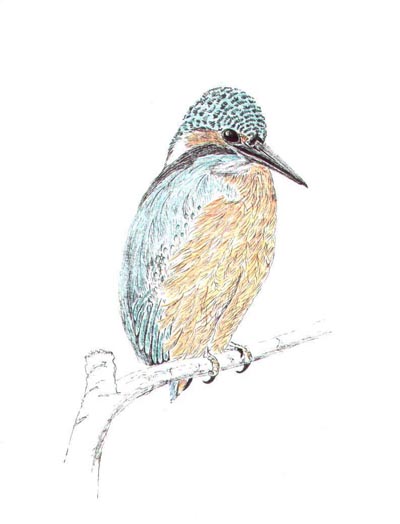
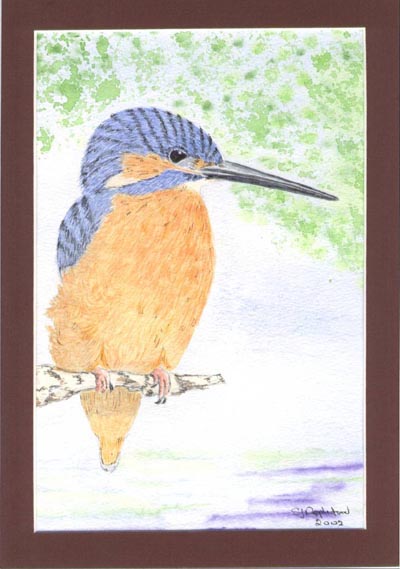
Ah! Kingfisher


It was just the sort of morning when the chill is an added disincentive to emerge from under the blanket. But the relentless dullness won't let one sleep in. So I slipped on my sneakers and stepped out onto the concrete driveway that circles our apartments. Enormous dust-bunny clouds smothered the morning sky.


Morning walkers huffed by trying to shrug off the weight of the breaking day. The first honks and rumbles of city traffic, cries of hawkers peddling fresh vegetables, another predictable day until something marvellous happened.


Perched on a wall bordering an open storm water drain, I saw a kingfisher. What was it doing there, in the middle of tall apartments and commercial buildings? Did the all but leafless, bent apology for a tree offer it a proper home? Would it find fish in the murky waters of the drain?


Perhaps the bird knew better than I. It flouted its brilliant blue feathers in a flash of eternal optimism and pursued its urge to thrive in the unlikeliest of places.


Refreshed by the morning breeze, I tried to learn more about this gorgeous bird. The numerous varieties thrive in the Americas, Africa and Asia. The bird I encountered bore a striking resemblance to his English cousins, and his Thai and Florida kins, too.


This lovely bird has inspired artworks, cartoons, and even stamps issued by countries like Congo and Guinea-Bissau. And this morning, my bird by the drain inspired me to look beyond the brick and glass of the cityscape.

Tuesday, November 21, 2006

Across the Pacific by Raft

It's been a spate of days when the sun plays truant behind dark clouds, when colds and allergies dampen one's spirits more than the drizzle outdoors. The best way to beat that 'under the weather ' feeling is to embark on an adventure. And a good book can be that ticket to a break from humdrum routines. I first read this book in school, and it continues to hold my interest.

KON-TIKI, Across the Pacific by Raft, is a true story of intrepid explorers. On April 28, 1947, scientist Thor Heyerdahl and five other adventurers sailed 4,300 nautical miles across the Pacific Ocean on a small raft to prove a historical hypothesis behind Polynesian folklore. Legend had it that the South Sea Islands were settled by a mythical hero named Kon-Tiki. Heyerdahl and his team tested this theory by replicating the flimsy log raft used by Kon-tiki’s ancient race to cross the Pacific. After sailing from Peru and braving three months on the open sea, these bold adventurers sighted land – the Polynesian island of Puka-Puka.

The narrative can get slightly tedious at times, with somewhat repetitive accounts of how fish jumped into the raft and became a meal. The author could also dwell a little more upon the inner lives and thoughts of the men aboard the raft rather than describe the many whales and sharks they encountered on the way. But patiently read the opening chapters, and you will be rewarded with a gripping saga of adventure and courage of men against the wild and dangerous sea. This classic has been translated into sixty-five languages and enjoyed by generations of readers worldwide.

Saturday, October 07, 2006

On cabbages, kings, and Mauryan art

How do teenaged students unwind between strenuous exams and perusing titanic tomes? Ask my son. He multi tasks by watching cartoons while munching a sandwich on the run. And when on the Net, he contributes to Wikipedia.
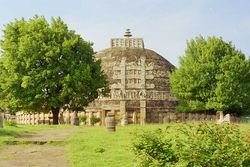
I knew little about Indian art in pre-Christian times before reading his Wikepedia piece on Mauryan Art The lion capital of Mauryan emperor Ashoka is a beautiful classic example of the sculpture of that era. Time has taken its toll and very few examples of such ancient Indian art survive. The carvings on the walls of the Sanchi Stupa, a Buddhist shrine, are another rare example.
He has written, among others, this entry on the Hindu Joint Family. If all this sounds off-beat, well, he's the son of an eccentric mother. He's calling me from the computer now for another heated debate about cabbages and kings.

Thursday, September 28, 2006

Time well spent

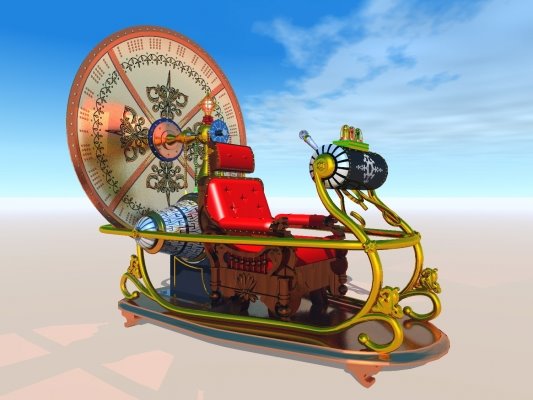
During a phase when creativity plays truant, I decided to shrug off inertia and reorganise my cupboards. Among piles of crumbling letters, lonesome single socks, and absurdly out of style dresses, I found a book. It was H.G.Wells' 'The Time Machine', a gift from a friend with whom I had lost touch long ago.


Settling into a gap among heaps of unsorted junk, I met the Time Traveller and followed him into the future.

Written a century ago, this novel is as fresh today as the first time I read it. Wells' view of the distant future is anti-utopian. In a satirical take on the social class divisions of his time, Wells foresaw a world where the human race evolved (degenerated?) into two distinct species. The dainty and effete Eloi are descended from the refined, idle aristocracy. The Morlocks are a sinister race descended from the working class, people who spent most of their lives in dark, airless sweatshops and ultimately became cannibalistic animals in the dark underbelly of the earth.

Embarking from the horriffic world of the Eloi and the Morlocks, the Time Traveller enters an even more terrifying future. In the dull glare of a bloated, dying sun, humanity has vanished without a trace. Giant crablike creatures dumbly await the impending end of the world.

Along with Jules Verne, H.G. Wells established science fiction as a serious literary genre. H.G.Wells' 'The Time Machine', 'The War of the Worlds', 'The Invisible Man', and other works are vivid and exciting even today.

Thursday, September 07, 2006

My friend Babar

While negotiating my way through Bangalore's busy Commercial Street some days ago, I overheard an exchange between a mother and her young son. To the mother's suggestion to visit a bookshop, the boy replied, "But all they have are the same old fairy tales and Harry Potter." The plump, pale boy typified today's urban children. He probably lived in an apartment and had no trees to climb or grassy nooks to explore. In all likelihood he spent his evenings doing homework and playing computer games.

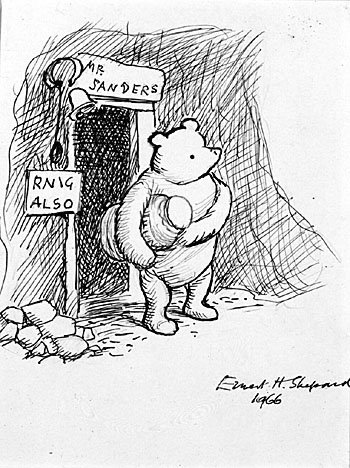
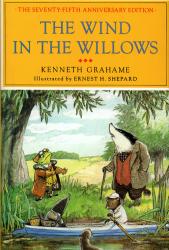
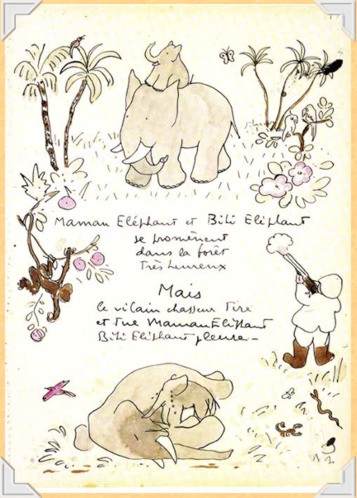
I, too, grew up in cramped partments in urban sprawls. But my father filled the house with books. Not content with what he found on shop shelves, he ordered more. While my parents were away at work, I curled up in my favourite sofa with Babar, the Little Elephant. Dear, cuddly and muddle-headed Winnie the Pooh and his friends and 'raletions' kept me company through many a lonely day. I loved the delighful river rat, the pompous Toad and all the other creatures populating The Wind in the Willows.

Exploring my school library led me to more treasures. Call It Courage, books by James Thurber and E.B. White, The Jungle Book, Black Beauty, The wizard of Oz, The Swiss Family Robinson, Tom Sawyer, the memories overwhelm me.
My son grew up reading my well worn copies of Babar, Robinson Crusoe, Five Little Peppers, Little Women and other books. When he wanted more, I scoured local bookshops in vain for Winnie the Pooh and other old-time favourites only to find the shelves filled with activity books, encyclopedias, fairy tales and classics retold (my child was an advanced reader for his age and would have preferred the originals).And there were the usual bestsellers. Nothing wrong with such books, but I sensed something sadly amiss in the paucity of choices.

Why do commercial interests take precedence in the type of reading on offer to children? Books that 'sell' occupy prominent display space and parents buy them. The same parents later complain that their children do not want to read. When we foist certain books upon children hoping to advance their intellectual capabilities, do we also not stifle their creativity for lack of ample choices? Why not allow them the freedom to make friends with Babar or Curious George?

Friday, September 01, 2006

The Lady turns fifty


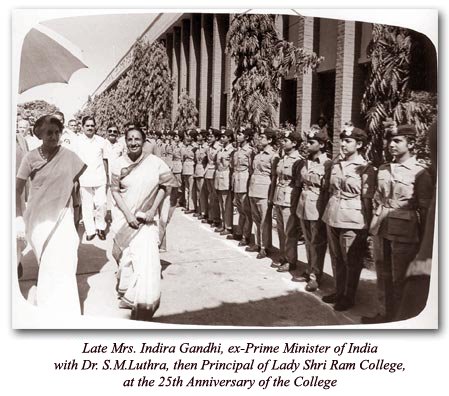
Yesterday, TV news channels aired clips of the Prime Minister parrying questions from bright young college girls. The session was part of the fiftieth anniversary celebrations of my alma mater, Lady Shri Ram College, University of Delhi.

I remembered my own college days; dear friends, teachers who encouraged us to delve deeper and ask questions.
I'll quote from the college's website;

"Years ago, while speaking at LSR's inaugural function on31stt July 1956, our founder Sir Shri Ram urged the students and teachers to "set for themselves a standard of behaviour and start good traditions". Faithfully so, the LSR community has not only fulfilled his desire, but has taken it up as a responsibility to promote these ideas to others as well.
Our students have always successfully imbibed in them a unique spirit of community, secular ideologies, a sense of democratic and institutional responsibility and above all the celebration of diversity. LSR has indeed helped all its students maintain a balance between excellence and social responsibility. Nobel Peace Prize winner, Aung Sang Suu Kyi and many many more well known academics, civil servants, social workers, artists, film makers, authors, educationists and lawyers comprise our alumna hall of fame."

No wonder LSR is ranked among the very best colleges in India. LSR ladies, you'll find them everywhere. You'll even find one lurking right here in the blogosphere.

Tuesday, August 29, 2006

Addas in Oxford?

Yes, it's in. The word 'adda' in my own native Bengali, has been offcially inducted into the Queen's English. You'll find it listed in the updated Oxford Dictionary.

I love the dynamism of the English language. And I love addas, an untranslatable word meaning, well, you know, groups of like or unlike minded folks in freewheeling intellectual discussions about cabbages and kings. The sort of thing that happpens in writers' groups. I would say even Blogspot, with its galaxy of unique voices, is one gigantic adda.

Other Indian inclusions into English are;

bindaas (Hindi) = carefree

chamcha= toady, flatterer, yes-man

chaddi = underpants

yaar = buddy

Saturday, August 26, 2006

A swell surprise

Something astonishing happened. I Googled my name and stumbled upon this

The post went on to say; "Monideepa Sahu (or Moni), always graceful, always kind, is featured at Pindeldyboz with the lovely Mother

Nicer things were in store. References to the San Francisco Bay Area and names of other writers offered no clue until I remembered. Yes, I 'met' Nadine Darling, a talented and accomplished writer, in Zoetrope . We reviewed each others short fiction, swapped friendly Z-mails, and then drifted out of touch. So nice of her to read my published story and remember me.

In a violent and selfish world where those upon whom we shower our affection often turn around to say, 'So what did you ever do for me?', this warmth from someone I have never personally met was amazing.

Friday, August 25, 2006

Sense in Nonsense

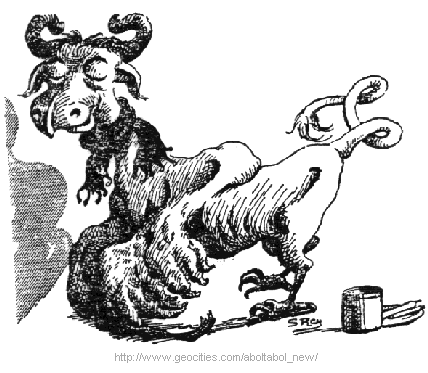
A friend sent me this picture and it reminded me of many people I've known. It also brought back memories of one of my favourite authors, Sukumar Ray, and his collection of nonsense poems in Bengali, 'Abol Tabol'.

Haven't we all met people who want everything? Well, all Sukumar Ray's Kimbhut Kimakar ever does is whine. Why can't he have wings and fly like a bird? Wow! Look at the elephant's imposing trunk. He must have one just like it. And if only he had the kangaroo's strong legs and could jump so high. On a cloudy monsoon day, he became everything that he wanted to be without even trying. Now he sits worrying. Can elephants jump up high? Can kangaroos live on banana leaves? What if people laugh at a fat old elephant that jumps and flies and sings like a cuckoo? What if someone asks him straight to his face? What can he call himself? "Oh god!", he groans. "I'm not a horse, elephant, snake or butterfly. I'm neither fish, nor plant, nor water, nor shoe nor umbrella. I am nothing then!"

Sukumar's greatest talent was his unique sense of humour. And it found it's best and most unforgettable expression in his Bengali book 'Abol Tabol' (Rhymes Without Reason). He saw the ordinary, boring world that we live in and found in it the absurd and the ridiculous. He turned the most common things upside-down to make his readers laugh. His humour was free from malice. But he did poke fun at the absurdities of human nature and draw from us a frank roar of laughter.


Meet Tansh Garu, sketched by Sukumar Ray himself to accompany his poems. He isn't a 'garu' or cow at all, but some sort of bird. Sukumar's drawings are as compelling as his words, convincing us that these creatures truly exist.

In Sukumar's topsy-turvy world, The absurd coexists with the commonplace and normal. Tansh Garu lives not in some exotic and distant jungle, but just across the street in friend Haru's office.


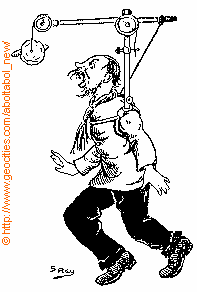
There are humans too, in the world of 'Abol Tabol'. Look at dear old Nanda Uncle, the jolly and adorable elder. Where's his endearing smile? He weeps recounting his visit to the astrologer. He has lived happily for sixty years unaware that he would die. But the astrologer predicted his impending death and ruined Nanda Uncle's peace of mind forever.

And here's Khudo with his miraculous invention, in another delightful sketch by Sukumar. Khudo's eco-friendly machine will solve the world's transport problems. Fit this machine on the laziest fellow, place his favourite snack where he can see and smell it but can't reach it, and you have the most efficient motivator. This machine will help a man run for miles without tiring or complaining.

In Sukumar Ray's works, the spirit of whimsical fun is masked by an apparent sophisticated seriousness. A hundred and nineteen years after his birth, his writing continues to evoke smiles and chuckles.

Sunday, August 20, 2006

writer's quest continues

Zafar, Deepika and Atyllah, thanks for visiting. I'm making this as a post and not a reply to your comments for the benefit of anyone else who chances to drop by and discover that we are in soups of similar viscosity. I don't know why I posted that earlier one, perhaps for people who keep asking why I dont publish my stories etc as books. I know even members of the relatively serious Indian writers' groups think it's a cinch to get works of fiction published and become rich and famous. Perhaps the 'success' of writers like Kavya Vishwanathan fuel their high hopes.

Selling an article on say, mehendi parties and wedding dresses to a foreign magazine is much, much easier than selling a short story collection or novel. And it's very lucrative. Agents/publishers don't have time for anything but polite 'form rejctions' for works of fiction they they don't want to represent. Those of us who frequent writers' groups have a pretty good picture of what those bland little 'thanks, but no thanks' slips really mean.

But what really raises hope and then makes the writer's heart plummet into the ravines of the Himalayas, is that 'encouraging rejection'. It often happens that an agent or editor likes your work enough to meet you personally and spend her valuable time discussing other ideas. They offer detailed and positive comments on your work and suggestions for changes which you may not agree with. They also offer to see more work from you.

But such 'encouraging rejections', though fewer and perhaps more esoterically valuable for the poor wannabe seeking publication, also can result in nothing.

I keep these rare ones in separate files. works nearly as well chocolates to lift a dismal mood. Here's an exerpt from one I got from an agent in New York;

Dear Monideepa,

I just finished reading your manuscript, and while I like your characters and the story's premise (a spider and rat transform into humans to help a family fight off an evil moneylender), I felt the story was too complex for your audience (ages 9-12 or maybe younger?). I liked the worlds of the story, but I found the treasure hunt difficult to follow and unnecessary: even though the rats needed gold to pay off the moneylender, in the end they got rid of him another way. The most interesting moments in the story are the relationships between the insects, rats and kids and the secret animal/insect worlds (original and fun).

When you're ready to write a new novel, you might like to look up some of the animal/insect novels on BN.com. Here's one search. If the link doesn't work, I gave you steps on how to get there.

Here you'll find synopses of featured titles in the trade market, sorted by publisher. You should be able to get a sense of the types of books they publish and where your writing fits in the marketplace. A follow-up visit to publishers’ web sites will yield further insights and lead to a new kind of focus in your writing—more to a publisher’s way of thinking.

Monideepa, thanks again for giving me an opportunity to read your novel--I enjoyed it and hope to read more of your work in the future.

Sincerely,

Debbie

****
As the PenguinIndia editor told me, and as Debbie the agent stresses at the end of her note to me, market forces play a big role in selecting works for publication. I subsequently learnt from other children's fantasy writers that, since there are already a spate of successful books in this genre in the market, publishers/agents aren't keen on trying out works from new writers at the moment.

Right timing and good marketing strategies matter. Nearly as much as polishing your writing to make it the best it can be.

Saturday, August 19, 2006

Independence Day and Janmashtami

August 15th was Independence Day, an independence which means different things to diverse people. As usual, I saw stories in news reports and in ordinary things happening around me.

An Englishman living in Bangalore wrote a letter to the editor. He felt that development and prosperity meant a lot more than an outcrop of swanky malls and high-rises. I totally agree. Everyone and their envious neighbours are buying bigger and more fuel guzzling and exhaust belching cars. People jostling for limited road space, everyone in a hurry to elbow others out of their way, road rage. They push unfortunate pedestrians into the spaces between gutters and construction material heaped on what used to be pavements. All, perhaps, for the freedom to acquire more, more, more.

On 16, we celebrated Janmashtami, the birth of Lord Krishna. A friend saw a stream of complicated and critical cases pouring into their hospital's labour wards; high risk cases which were beyond the capacity of smaller nursing homes and health centers. The friend returned home a bit past dinner time, exhausted but jubilant. In such difficult cases, it is not uncommon for the babies to die along with their mothers despite doctors' best efforts.

But on Janmashtami day, all of them survived and are on their way to complete recovery. For us this was the best celebration.

Saturday, August 12, 2006

What writers want

Mountain ranges and canyons seem to divide what writers want from the priorities of an editor or publisher. Some years ago, one of the senior editors at Deccan Herald gave me an intro to a Penguin editor. I emailed her and sent a sample of my childrens writing as requested. And then she suggested we meet.

She was very polite and businesslike, particulalrly liked one of my ideas, and I went ahead and wrote a novel. She saw it, said nice things, and I felt on top of the world, dreaming BIG dreams.

but...It wasn't good enough fo them to buy the book. She explained privately that promoting new writers was extremely tricky. I got the distinct hint that especially if a writer wasn't into the arty party circuits and knew everyone who matters, people will wonder who the heck is this and not take interest in a nobody. If a writer is already well-known, it is that much easier to proftably sell his books. Bottom line: marketing and profits count. Unless a new writer can make a particular editor fall in love with his work, it won't get published. A very iffy business on the whole. Unknown writers like me are poor business propositions.

To me it seemed like the chicken or egg conundrum.

She did like my work enough to try to put me on to translating childrens stories, and I worked on some of her sugestions. But nothing came of it. Basically, all publishers look at the business side and after much writing and discussing, no deal may come through.
At this stage, I decided to stop writing things to 'fit in' to the needs of publishers. Now, I write about what I feel like, where my heart leads me. Not expecting to make megabucks or waiting for the biggies to come flying with gilt edged contracts to my doorstep. Not because I don't need money. We're simple middle class folks. But I feel I've slogged in the rat race long enough, so I deserve a bit of personal freedom. So if an editor/publisher likes it, fine. If he doesn't, I never expected anyone to.

I know many talented but unknown writers who are nothing of consequence. As yet.

I feel everyone starts at that point. Luck and hard work determine where they go from there

This is where I am right now, refining my writing to make it the best it can be and searching for an audience. The story continues.

Wednesday, August 09, 2006

A Gandhian Passes

A couple of days ago, the newspapers announced the passing of Mahadevi Tayi, a veteran freedom fighter. This venerable nonagenarian was a child widow and a disciple of Mahatma Gandhi. I had the opportunity to interact with her some years ago. Here's an account.

Tucked away in a quiet, tree-lined lane in Bangalore's Kumara Park, is a spacious compound with many large trees. Inside, there are some simple cottages recreating a typical a village setting. This is a home for the aged and orphans. Upon entering, I was greeted by a fair, aged lady wearing a white sari, conversing with a younger lady in saffron. "Was this ashram really blessed by Acharya Vinobha Bhave?" I asked, pointing to a plaque.

"Oh yes. I was his sevika, and a freedom fighter", said Mahadevi Tayi, the lady in white. "See, there's my photograph on the wall, along with Acharya Vinobhaji, and Pandit Nehru."
"It's all like a story now. I was young and full of energy. Now I'm ninety-four,"Mahadevi Tayi continued. "Those were heady days. Every heart was filled with idealism and patriotic feelings. Gandhiji was a great leader, who called everyone to do non-violent satyagraha against oppressive British rule. I grew up in Wardha under his influence. The young and old, women and children all enthusiastically joined the Freedom Movement.

"At first, the women were shy, but they gained confidence to do satyagraha. Many women were imprisoned along with their husbands. Their property was confiscated by the British, leaving the children destitute. I ran an ashram for three hundred such children, hiding my work from the British government. I was jailed for this, and on three other occasions as well. I even underwent rigorous imprisonment with criminals, and solitary confinement. But we had the courage to withstand hardship, and sacrifice our personal comfort for the sake of our country.
During the Razakar Andolan in the princely state of Hyderabad, Vinobhaji was called. Vinobhaji went on a padyatra in rural areas for fourteen years. Many men and women from all parts of the country followed him. I was constantly by his side. Vinobhaji saw wide disparities among the rich, landed people, and the poor, landless peasants. Vinobhaji asked the rich to donate land for distribution among the poor. This was the Bhoodan Movement."

Channamma Hallikere, the lady in saffron, had her own story to tell. "As freedom fighters, my parents were imprisoned many times. As a one-year old baby, I stayed in Dhulia jail with my mother. When my parents were jailed, the British confiscated our property. I now live in Vinobhaji's ashram in Wardha. He started this ashram for uniting women workers. It is a community of women, including foreigners, living together in cooperation and harmony as brahmacharis. I conduct three-day camps for people in rural areas, helping them and spreading the teachings of Gandhiji and Vinobhaji in Kannada. I have been doing social work for fifty years."

"Helping and encouraging the people in the ashram keeps me busy", said Mahadevi Tayi. "Nobody is destitute or anath. God is everyone's nath."

Wednesday, August 02, 2006

Burichang and Kudutai

Long ago and far away, my forefathers had a homeland; a sylvan paradise which they left forever after India was partitioned. My elders told dreamy stories about a lost Arcadia of milk, honey and communal amity. That home was a village called Burichang.

Burichang has grown into a sub-divisional town in Comilla District now, in a foriegn country named Bangladesh. My uncle visited there recently and told us how the family home now houses governement offices and a school.

Born in free India, growing up in capital cities like New Delhi and Washington D.C., I listened with incredulity to what seemed like fairy tales of a lost Eden. I never lived in a real Indian village, never visited one until I did my rural and agricultural banking postings as a probationary officer with the State Bank of India group.

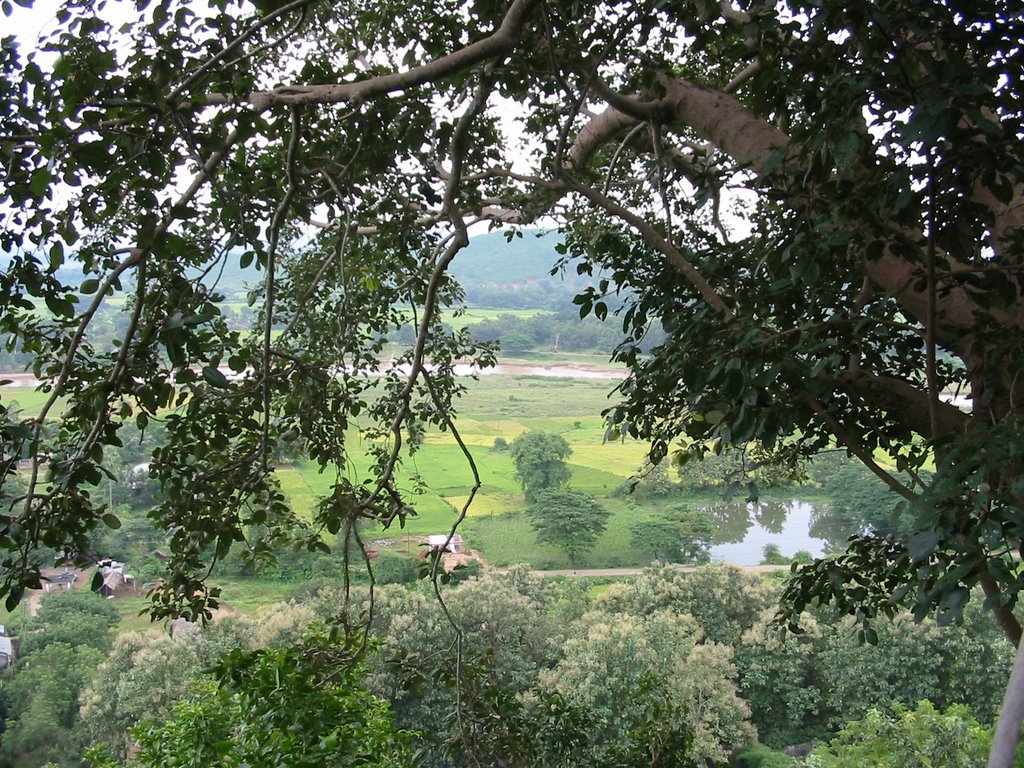
I finally inherited a genuine rural address by marriage, village Kudutai, dist Ganjam, Orissa. The emerald paddy fields and groves of cashew trees with luscious red cashew apples, the undulating hills, yes, this is a paradise on earth.

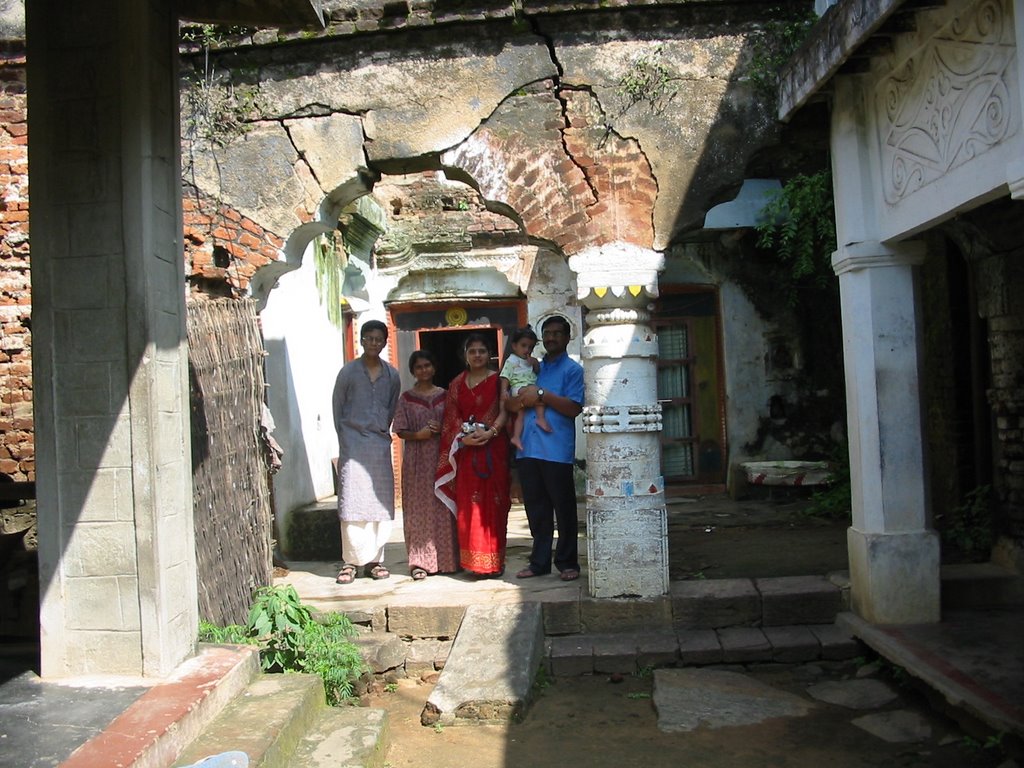
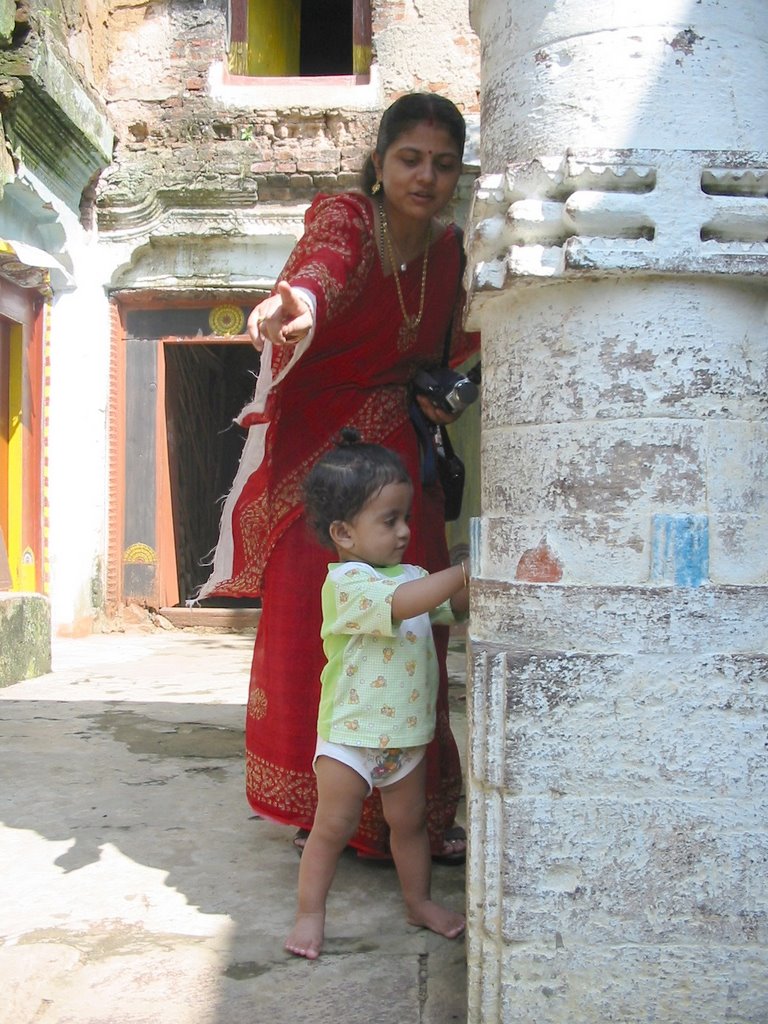
The now crumbling ancestral mansion still displays signs of old grandeur in the massive decorated pillars and ornamental doorways. These were once scenes of community festivities, of village panchayats and dispensation of justice.

The old mansion now lies abandoned, like the beached body of a magnificent whale. Descendants of the clan live in featureless matchbox quarters with modern amenities huddled behind the grand facade of the original house.

Seeing the beauty of Kudutai, I now understand what my own parents and elders still mourn. I also see that it is no unspoilt paradise. Kudutai is an ordinary village in a remote corner of a less developed state of India. Electricity came here only at the fag end of the twentieth century. A few months ago, a young cousin died of cerebral malaria. There are no doctors or hospitals in the village.

The younger generation of the family are now entering into service oriented professions. Idealism can also motivate.

Tuesday, August 01, 2006

Exchanging critiques and Igniting friendships

I've learnt a lot over the years workshopping my stories in Zoetrope Studios and the IWW. In the course of exchanging critiques and writing tips, I've found a few special friends . We've never met in person, but that has never been a barrier. Some of them are like family now, and I'm fortunate to have them around. Announce a new publication, and workshop members cheer you on. Air your frustrations when those rejection notes pile up, and friends motivate you to never give up.

Sometimes friends return after a long absence to share disconcerting news. I felt so sad when Deepa wrote in to say;
"our home along with all other buildings in our area for a 20 km stretch -- homes, shops, hospital, schools, temples, bank, industries, etc. is going to be demolished in 2007 as the govt. has decided they want to expand the highway! This would displace over 100,000 people and render at least another 100, 000 unemployed apart from breaking up families as some have to stay on in the area due to the jobs while others have to move.

And there are moments of pure fun like when Beth returned up after years, now as the happy mother of a baby girl. We plunged into a critique exchange and a heated discussion on a shared passion for hot chilies. We use a lot of the stuff , call them chilies or mirchi in Hindi. In my own mother tongue, Bengali, they're called 'lanka', not as in Sri Lanka, but well...A Chili by any other name is just as fiery.
Beth tells me about her home, New Mexico, "where chile is not just a food, it's a way of life... When Green Chile Season rolls around (September usually), everyone buys their big bushel sacks full of chile and spends an afternoon roasting them on the grill, drinking beer, and eating bits of roasted green chile rolled in tortillas. The smell is amazing and the whole harvesting season is something everyone looks forward to all year long.
In New Mexico, "chili" refers to the stew-like concoction of beef, beans, onions, spices, etc.
More than you ever wanted to know about New Mexico chile! Can you tell I'm passionate about it? "

This is how we share stories, and discover newer ones.